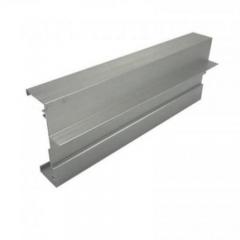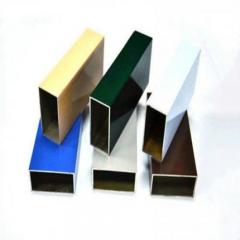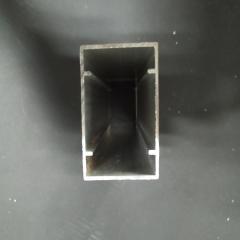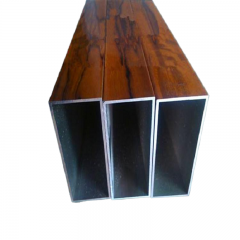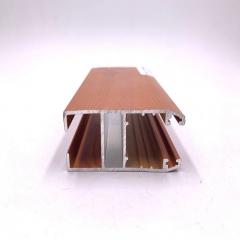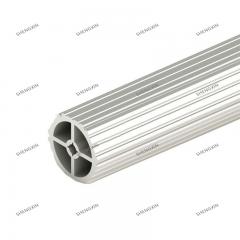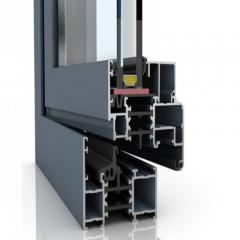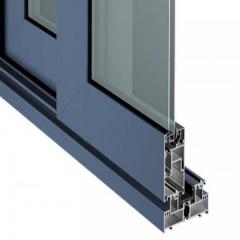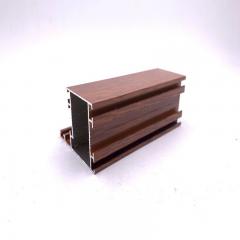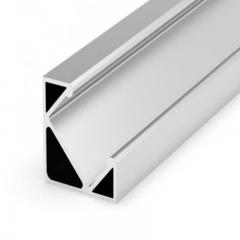
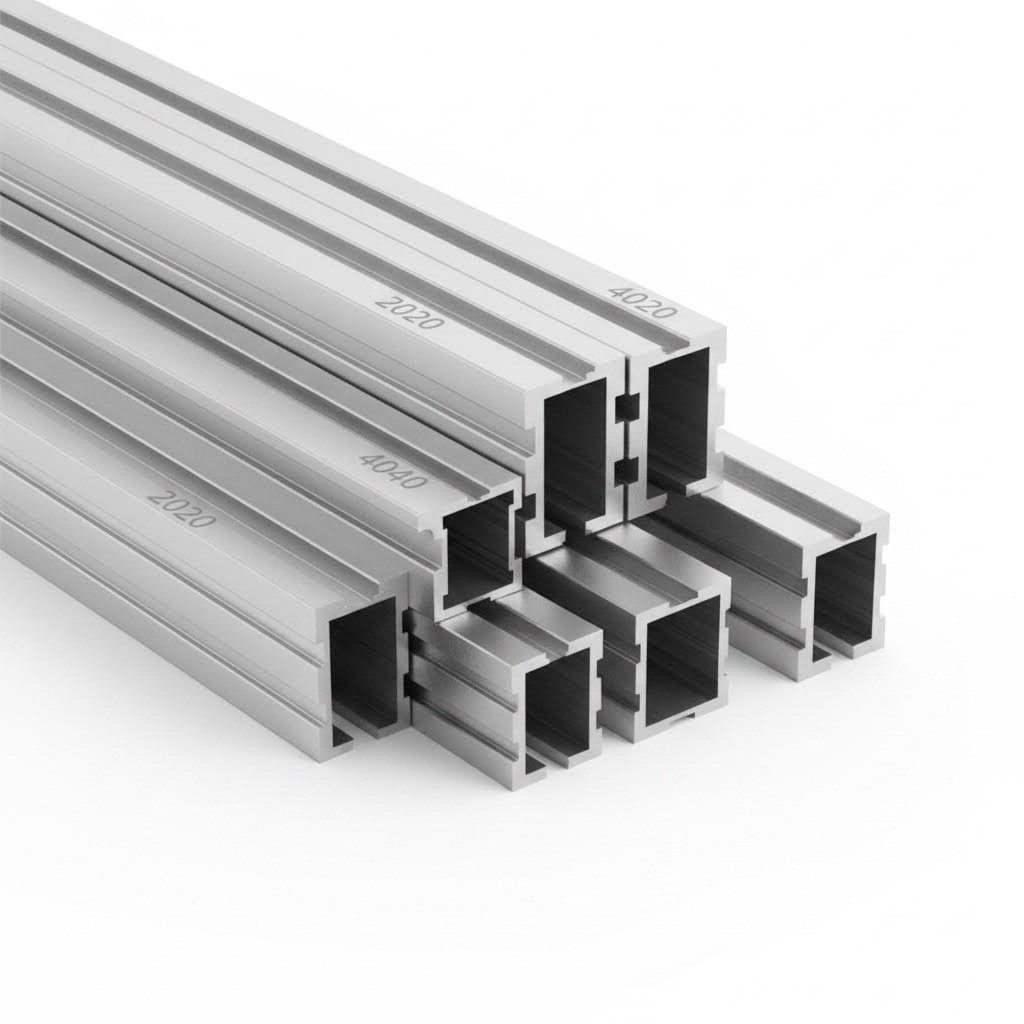
When you're building a 3D printer frame, designing a CNC router, or assembling custom workstations, one question inevitably surfaces: how strong is 2020 aluminum extrusion, really? Whether you're a hobbyist tackling your first DIY project or an engineer specifying components for industrial automation, understanding this profile's strength characteristics is essential for success.
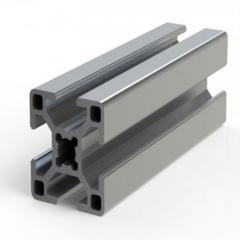
So what exactly is 2020 aluminum extrusion? The name says it all - it refers to a square T-slot aluminum profile with cross-sectional dimensions of 20mm x 20mm. This makes it the smallest standard profile in the T-slot family, sitting below larger siblings like 2040, 4040, and 8020 profiles.
The 2020 extrusion typically features four open T-slots - one on each face - allowing you to attach hardware, mount accessories, and connect profiles from any direction. These profiles are constructed using quality aluminum alloy with European Standard dimensions and approximately 1.5mm structural cross-section thickness. The aluminium 2020 profile has become particularly popular for lightweight structural frameworks, including DIY 3D printers, CNC routers, camera sliders, and robotic arms.
Imagine squeezing a tube of toothpaste - the force you apply pushes material through the opening in a specific shape. The extrusion process works similarly, forcing heated aluminum alloy through a die to create these precise T-slot profiles with consistent dimensions throughout their length.
Here's something that might surprise you: the strength of your 20 20 aluminum extrusion isn't determined by a single factor. Instead, it's the result of multiple variables working together. Understanding these factors helps you predict performance and make smarter design decisions.
Key factors that determine 2020 aluminum extrusion strength include:
What does this mean for your project? A 2020 aluminum profile can handle surprisingly demanding applications when properly engineered. The same extrusion that seems flimsy in isolation becomes remarkably robust when integrated into a well-designed frame with appropriate brackets, gussets, and fastening hardware. As you'll discover in the following sections, matching your profile choice to specific load requirements - while paying careful attention to connection quality - is the real secret to successful aluminum framing projects.
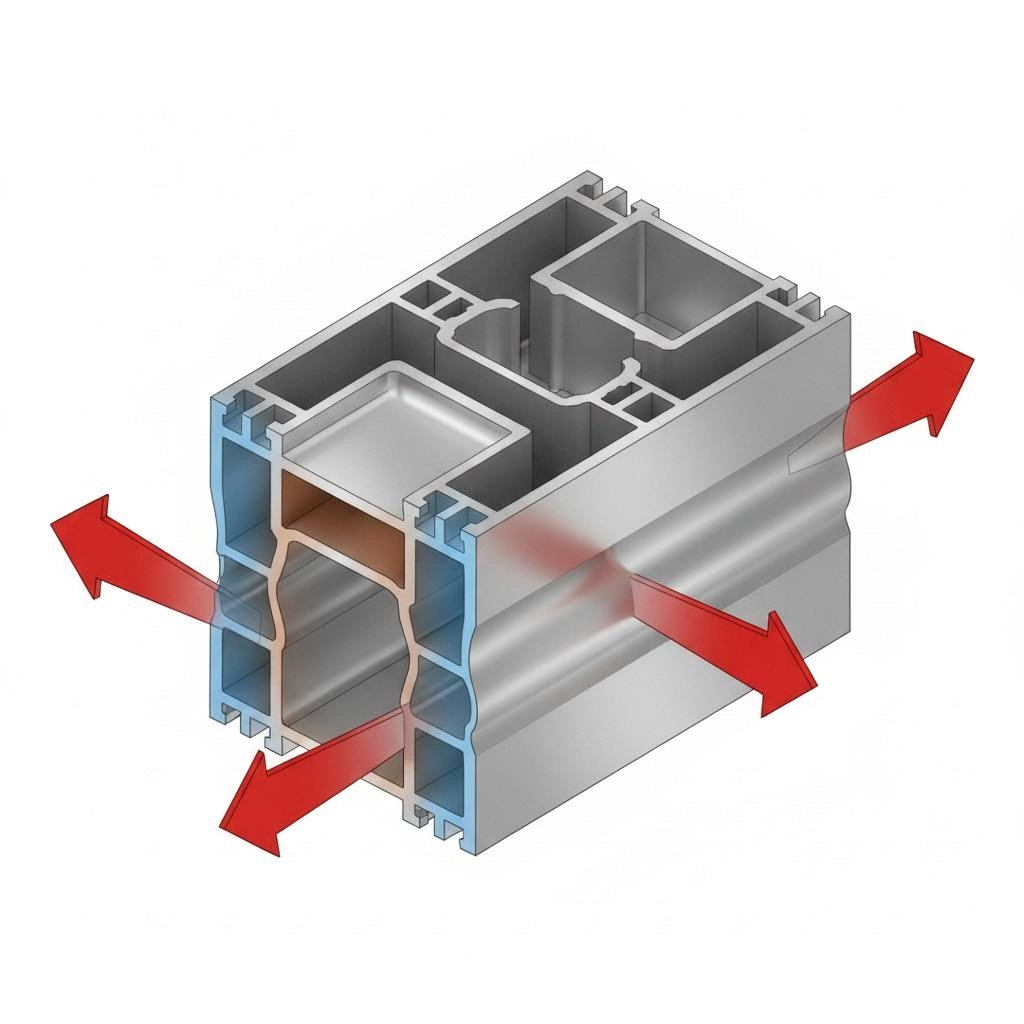
Now that you understand what determines 2020 aluminum extrusion strength, let's dive into the actual numbers. When evaluating 8020 aluminum material for your project, two mechanical properties matter most: tensile strength and yield strength. These measurements tell you exactly how much stress your aluminum 2020 profile can handle before things go wrong.
Here's where many builders make critical mistakes. Not all 2020 extruded aluminum is created equal. The two alloys you'll encounter most often - 6061-T6 and 6063-T5 - offer dramatically different performance characteristics. Understanding these differences helps you match the right material to your application.
What is 8020 aluminum, exactly? The term refers to T-slot aluminum extrusion systems, which can be manufactured from either alloy. According to ASM International material data, 6061-T6 aluminum delivers an ultimate tensile strength of 310 MPa (45,000 psi) with a yield strength of 276 MPa (40,000 psi). This alloy offers excellent joining characteristics, good workability, and high resistance to corrosion - making it ideal for structural applications where strength is paramount.
In contrast, 6063-T5 aluminum provides an ultimate tensile strength of approximately 185 MPa (27,000 psi) with a yield strength of 145 MPa (21,000 psi). While these numbers appear significantly lower, 6063-T5 compensates with superior surface finish, excellent extrudability for complex thin-walled shapes, and outstanding anodizing response.
| Alloy Type | Tensile Strength | Yield Strength | Best Applications | Surface Quality |
|---|---|---|---|---|
| 6061-T6 | 310 MPa (45,000 psi) | 276 MPa (40,000 psi) | Structural frames, CNC machines, heavy-duty workbenches, aerospace fittings | Good - suitable for anodizing |
| 6063-T5 | 185 MPa (27,000 psi) | 145 MPa (21,000 psi) | Architectural applications, 3D printer frames, enclosures, decorative trim | Excellent - superior anodizing and finishing |
Sounds complex? Let's break it down. Tensile strength measures the maximum stress your 2020 aluminum extrusion strength can withstand before fracturing completely. Yield strength - the more practical number for design purposes - indicates when permanent deformation begins. Once you exceed yield strength, your profile bends and stays bent.
For engineering-minded readers, two additional properties deserve attention: section modulus and moment of inertia. The moment of inertia describes how a profile's cross-sectional geometry resists bending. A higher moment of inertia means greater stiffness under load. The section modulus, derived from moment of inertia, directly relates to bending stress calculations - it tells you the maximum load a beam can carry at a given span before exceeding allowable stress.
With a 20mm x 20mm profile, the compact cross-section naturally limits these values compared to larger profiles. However, 2020 extrusions still perform remarkably well for their size. According to Kaiser Aluminum technical specifications, both 6061 and 6063 alloys share a modulus of elasticity of approximately 69 GPa (10,000 ksi), meaning they exhibit identical stiffness characteristics regardless of ultimate strength differences.
What does this mean practically? When selecting between alloys, consider your primary requirements. Choose 6061-T6 when maximum 2020 aluminum extrusion strength is essential - think heavy CNC routers or industrial automation frames. Opt for 6063-T5 when aesthetics matter, when you need complex profile geometries, or when the application doesn't demand ultimate structural performance. Many 3D printer builders find 6063-T5 perfectly adequate while benefiting from its superior surface finish after anodizing.
You've got the material properties down. Now comes the question every builder really wants answered: how much weight can your 2020 extrusion actually support? The answer depends heavily on two factors you might not immediately consider - the orientation of your profile and the unsupported span length between connection points.
Imagine holding a ruler vertically between your palms versus laying it flat across two supports with weight in the middle. The same piece of material behaves completely differently depending on how forces are applied. Your 20x20 extruded aluminum follows the same principle.
When used as a vertical column, 2020 extrusions handle compression loads - forces pushing straight down through the profile's length. In this orientation, the aluminum resists buckling rather than bending. A properly supported vertical 2020 column can handle surprisingly substantial loads because the entire cross-section shares the compressive stress.
Horizontal beams tell a different story. Here, gravity creates bending stress, with the top surface experiencing compression while the bottom surface stretches under tension. This loading scenario is far more demanding on your 2020 aluminum extrusion dimensions. The profile's moment of inertia - that geometric property we discussed earlier - becomes the critical factor determining how much weight the beam supports before deflecting excessively.
Why does this matter for your project? A 2020 profile that works perfectly as a vertical support might flex unacceptably when used horizontally across the same distance. Understanding this distinction prevents frustrating redesigns later.
Here's something that catches many first-time builders off guard: doubling your span length doesn't just double the deflection - it increases it by a factor of eight. This cubic relationship means span length dramatically impacts your 2020 extrusions' practical load capacity.
According to MISUMI's Aluminum Extrusions Load Capacity Guideline, a standard HFS5 2020 profile (20mm x 20mm) has a section modulus of 0.74 x 10³ mm³ and a sectional moment of inertia of 0.74 x 10⁴ mm⁴. These values translate into specific allowable loads based on span length:
| Span Length | Orientation | Allowable Load (N) | Allowable Load (kgf/lbs approx.) | Practical Applications |
|---|---|---|---|---|
| 300mm (~12 inches) | Horizontal beam | ~165 N | ~17 kg / 37 lbs | Short shelf supports, sensor mounts, light fixtures |
| 500mm (~20 inches) | Horizontal beam | 99 N | 10 kg / 22 lbs | 3D printer bed supports, small enclosure frames |
| 1000mm (~39 inches) | Horizontal beam | 24 N | 2.4 kg / 5.3 lbs | Light cable management, non-structural cross members |
| Any length | Vertical column (compression) | Significantly higher | Varies by height/bracing | Frame uprights, support posts, structural columns |
These values represent allowable loads defined as forces generating deflection equal to 1/1000 of the extrusion length - a common engineering standard for structural applications. The calculations assume centralized loads on both-ends-supported extrusions, which represents typical real-world mounting scenarios.
Notice how the allowable load drops from 99 N at 500mm span to just 24 N at 1000mm? That's the cubic relationship in action. When comparing 8020 extrusion dimensions across different profile sizes, you'll see this same pattern - larger profiles resist this effect better due to their higher moment of inertia.
The numbers in the table above represent maximum allowable loads - not what you should actually apply in practice. Smart engineering incorporates safety factors to account for unexpected stresses, material variations, and long-term reliability.
For structural applications, typical safety factors range from 3:1 to 5:1. What does this mean practically? If your 2020 aluminum extrusion dimensions indicate a 99 N allowable load at 500mm span, your working load limit with a 3:1 safety factor becomes approximately 33 N (about 3.3 kg or 7.3 lbs). This conservative approach ensures your structure handles real-world conditions including vibration, impact loads, and material fatigue over time.
Precision applications demand even stricter attention to deflection limits. Consider a 3D printer: even if your frame can technically support the print bed's weight, excessive deflection during rapid movements causes print artifacts, layer inconsistencies, and dimensional inaccuracies. For CNC machines, deflection translates directly into cutting errors and poor surface finish.
When designing for precision, many engineers specify deflection limits of L/500 or even L/1000 (where L equals span length). At these tighter tolerances, your allowable working loads decrease further - but your finished project performs exactly as intended.
The takeaway? Always calculate your actual load requirements, apply appropriate safety factors, and consider whether deflection limits matter for your specific application. A decorative enclosure tolerates more flex than a laser engraver frame, so match your design approach to your performance requirements.
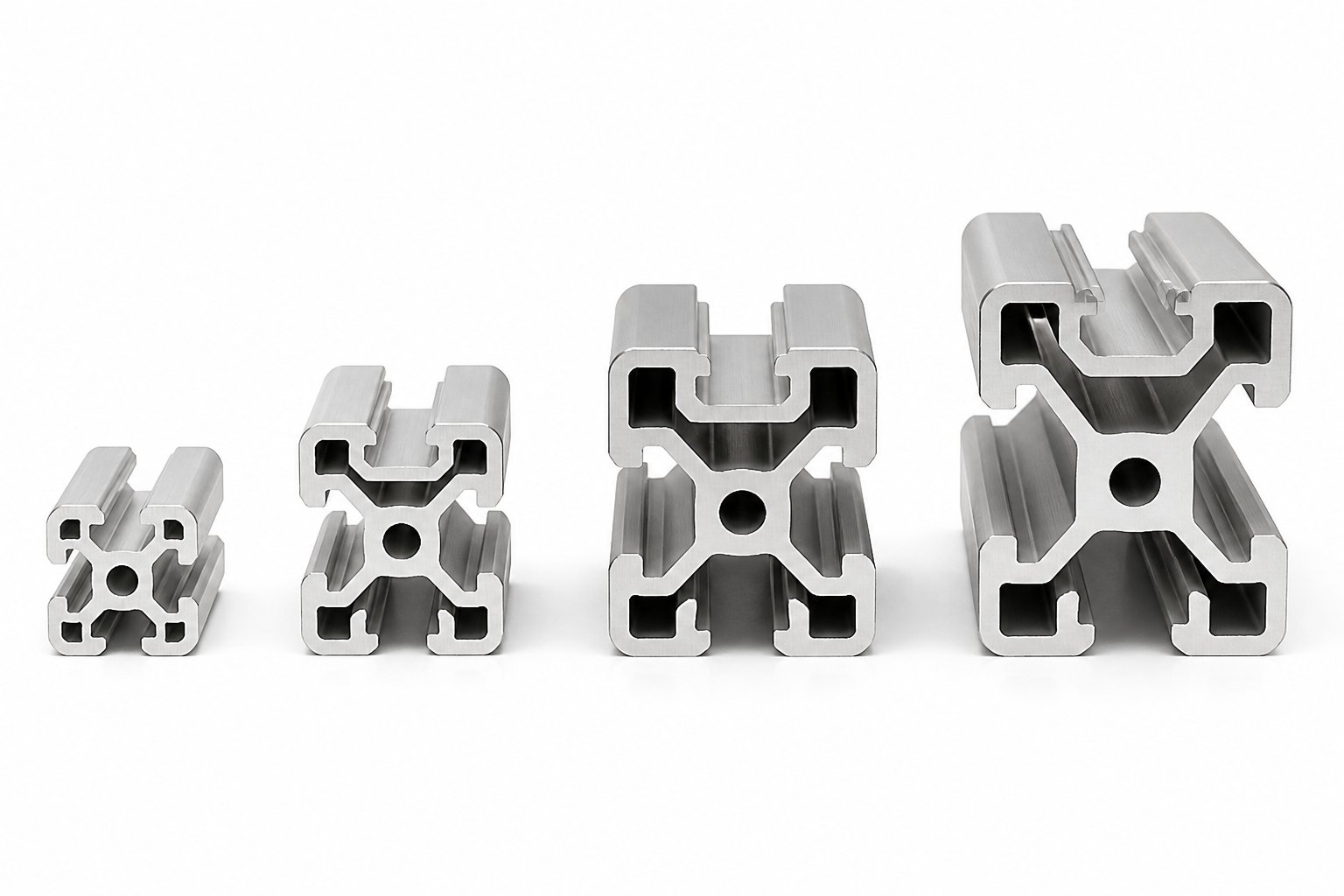
Understanding how 2020 extrusion performs in isolation is valuable, but real-world projects rarely use a single profile size. Most successful builds combine multiple extrusion dimensions strategically. So how do the popular sizes stack up against each other? The answer involves some surprising math that explains why larger profiles deliver exponentially - not linearly - greater strength.
When you double an extrusion's dimensions, you might expect double the strength. The reality is far more impressive. A 4040 extrusion isn't twice as strong as a 2020 - it's roughly 12 times stronger in bending resistance. This dramatic difference comes down to the moment of inertia, which increases with the fourth power of the profile's height.
According to MISUMI's technical specifications, here's how the most common profile sizes compare in actual load-bearing performance:
| Profile Size | Cross-Section Dimensions | Moment of Inertia (x10⁴ mm⁴) | Allowable Load at 500mm (N) | Relative Strength vs 2020 | Weight per Meter (approx.) |
|---|---|---|---|---|---|
| 2020 | 20mm x 20mm | 0.74 | 99 N (10 kgf) | 1x (baseline) | ~0.5 kg |
| 2040 | 20mm x 40mm (loaded on 40mm face) | 5.11 | 687 N (70 kgf) | ~7x stronger | ~0.9 kg |
| 4040 | 40mm x 40mm | 8.9 | 1,196 N (122 kgf) | ~12x stronger | ~1.5 kg |
| 8080 | 80mm x 80mm | 129.8 | 17,438 N (1,778 kgf) | ~176x stronger | ~5.0 kg |
Notice something interesting about the 2040 aluminum extrusion? Orientation matters dramatically. When you load a 2040 aluminium extrusion on its 40mm face (the stronger orientation), you get approximately 7 times the load capacity of a 2020. Flip it to load on the 20mm face, and that advantage shrinks considerably. This asymmetric behavior makes 2040 extruded aluminum particularly versatile - you can orient it strategically based on where loads actually occur.
The 8020 aluminum extrusion dimensions reveal why this profile dominates heavy industrial applications. With a moment of inertia of 129.8 x 10⁴ mm⁴, it handles loads that would require multiple smaller profiles working together. When reviewing 2040 aluminum profile specifications against 8080 options, you're looking at roughly 25 times the strength difference - a gap that matters enormously in machine frames and structural applications.
So when should you step up from 2020 to a larger profile? Consider these practical guidelines:
Here's where smart builders gain an edge: you don't need uniform profile sizes throughout your project. The most efficient designs use larger profiles where strength matters and smaller profiles where it doesn't.
Consider a typical 3D printer enclosure. The vertical corner posts carry compression loads and benefit from 2040 or 4040 profiles. But the horizontal cross-members near the top - supporting only lightweight panels and perhaps LED strips - work perfectly fine with 2020 extrusion. This hybrid approach reduces weight, cuts costs, and simplifies assembly without compromising structural integrity.
According to ProLean Tech's analysis, 2020 profiles excel in specific roles even within larger structures:
The key insight? Match profile size to actual load requirements at each location. Your primary frame members - the ones carrying weight, resisting racking forces, and maintaining dimensional stability - deserve appropriately sized profiles. Secondary elements can use smaller, lighter, more economical 2020 extrusions without compromising overall performance.
This strategic approach explains why experienced builders keep multiple profile sizes in stock. Understanding exactly how T-slot design and connection methods affect your structure's ultimate strength - the topic we'll explore next - helps you make these decisions with confidence.
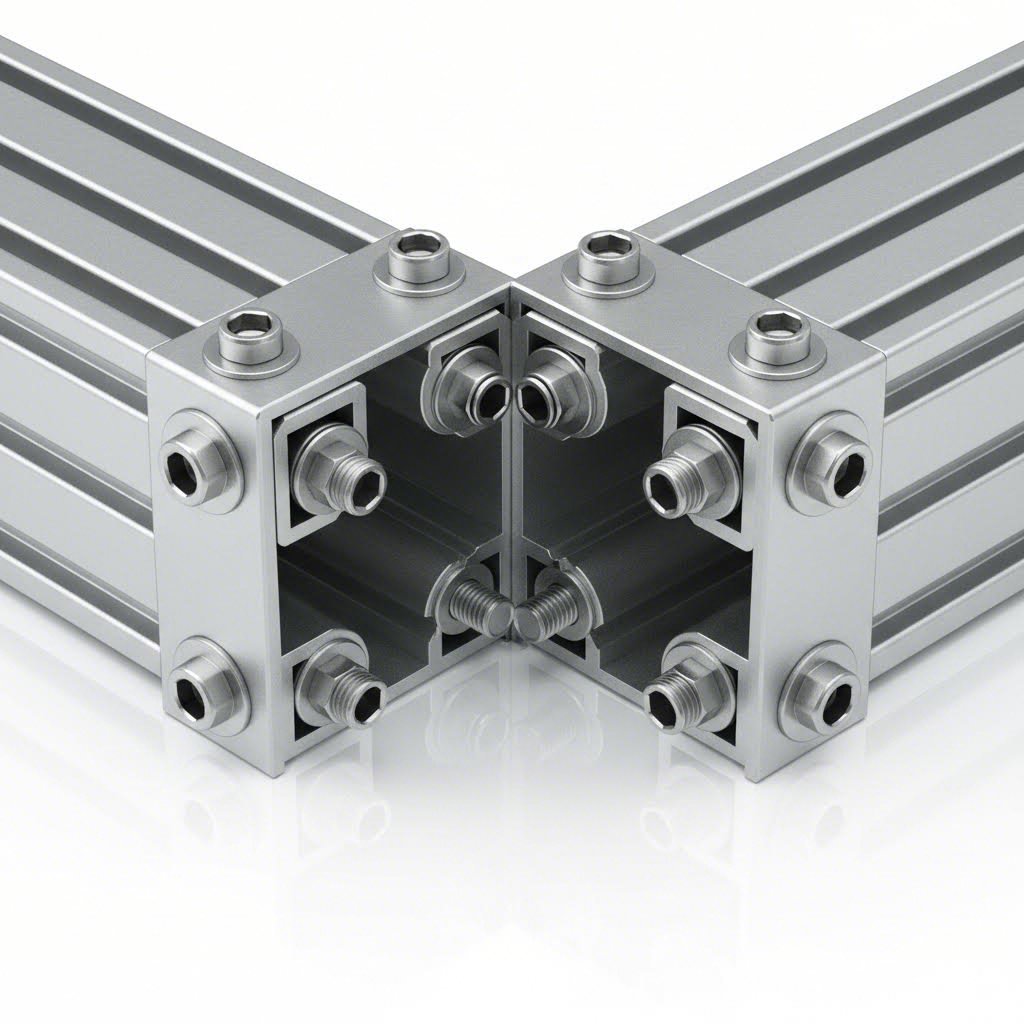
Here's a truth that surprises many first-time builders: your 2020 profile might handle impressive loads on its own, but your finished structure is only as strong as its weakest connection. When asking how strong is 2020 aluminum extrusion, the answer depends as much on how you join profiles together as on the aluminum itself. In fact, joint failure accounts for the majority of structural problems in T-slot assemblies - not the extrusion material.
The distinctive T-shaped channel running along each face of your 20 20 extrusion does more than provide mounting convenience. This geometry fundamentally defines how forces transfer through your structure. Understanding it helps you design connections that maximize your aluminum extrusion 8020 system's potential.
Each T-slot features a narrow opening that widens into a broader channel beneath the surface. This profile allows specialized nuts and hardware to slide into position, then lock firmly when fasteners tighten. The slot walls themselves become load-bearing surfaces, distributing clamping forces across a larger area than a simple drilled hole would allow.
Single-slot versus dual-slot configurations affect your design options significantly. Standard 20 x 20 extruded aluminum features one T-slot per face - four slots total. Larger 2020 profile variants may include dual parallel slots on wider faces, offering more mounting points and improved load distribution for heavy-duty applications. When considering aluminium extrusion bending resistance, multiple connection points along a joint dramatically improve rigidity compared to single-point fastening.
The geometry also influences how your structure handles different stress types. Slots aligned parallel to applied forces resist sliding loads effectively. Slots perpendicular to forces rely more heavily on friction and clamping pressure. Orienting your profiles so T-slots align with expected load directions builds inherent strength into your design.
Your choice of connection hardware transforms the theoretical strength of 20 x 20 extruded aluminum into real-world performance. According to Phidgets' T-Slot Guide, several connection methods serve different structural requirements:
The choice between internal and external corner connectors depends on your structural requirements and aesthetic preferences. External brackets add visible reinforcement and are easier to install, making them ideal for functional frames where appearance matters less. Internal connectors hide within the profile geometry, creating cleaner lines but requiring more precise drilling and assembly.
The weakest point in most T-slot assemblies is the joint, not the extrusion itself. Proper hardware selection and installation technique matter more than the aluminum's inherent strength.
Even the best hardware underperforms when installed incorrectly. These practices ensure your 2020 profile connections achieve their full potential:
According to research on aluminum joining techniques, proper surface preparation before assembly also affects long-term joint integrity. Clean mating surfaces, correctly seated nuts, and appropriate thread engagement depth all contribute to connections that maintain their strength over years of service.
The practical takeaway? Invest time in connection quality. A carefully assembled frame using standard hardware outperforms a hastily built structure using premium components. With your joints properly designed and executed, you're ready to match these connection strategies to specific application requirements - which we'll explore next.
You've learned the numbers, understood the material properties, and grasped how connections affect performance. But here's the question that really matters: is 2020 aluminum extrusion strong enough for your specific project? The answer depends entirely on what you're building. A profile that performs flawlessly in one application might fail spectacularly in another - not because the aluminum changed, but because the demands did.
Different projects stress aluminum framing extrusion in fundamentally different ways. Understanding these distinctions helps you match the right profile to your needs - or recognize when reinforcement becomes necessary.
Knowing when 2020 is NOT strong enough saves you from frustrating rebuilds. Consider these warning signs that suggest upgrading to larger profiles:
Sometimes 2020 extrusion is almost strong enough - and strategic reinforcement closes the gap more economically than switching to larger profiles entirely. These techniques extend what's possible with 20mm aluminum extrusion:
The most successful aluminum framing projects start with honest assessment of actual requirements. Undersizing leads to frustrating performance problems; oversizing wastes money and adds unnecessary weight. By matching profile selection and reinforcement strategies to your specific application demands, you build structures that perform exactly as intended - whether that's a precision CNC router or a simple equipment enclosure. With these application insights in hand, you're ready to consider how aluminum compares to alternative materials like steel for your structural needs.
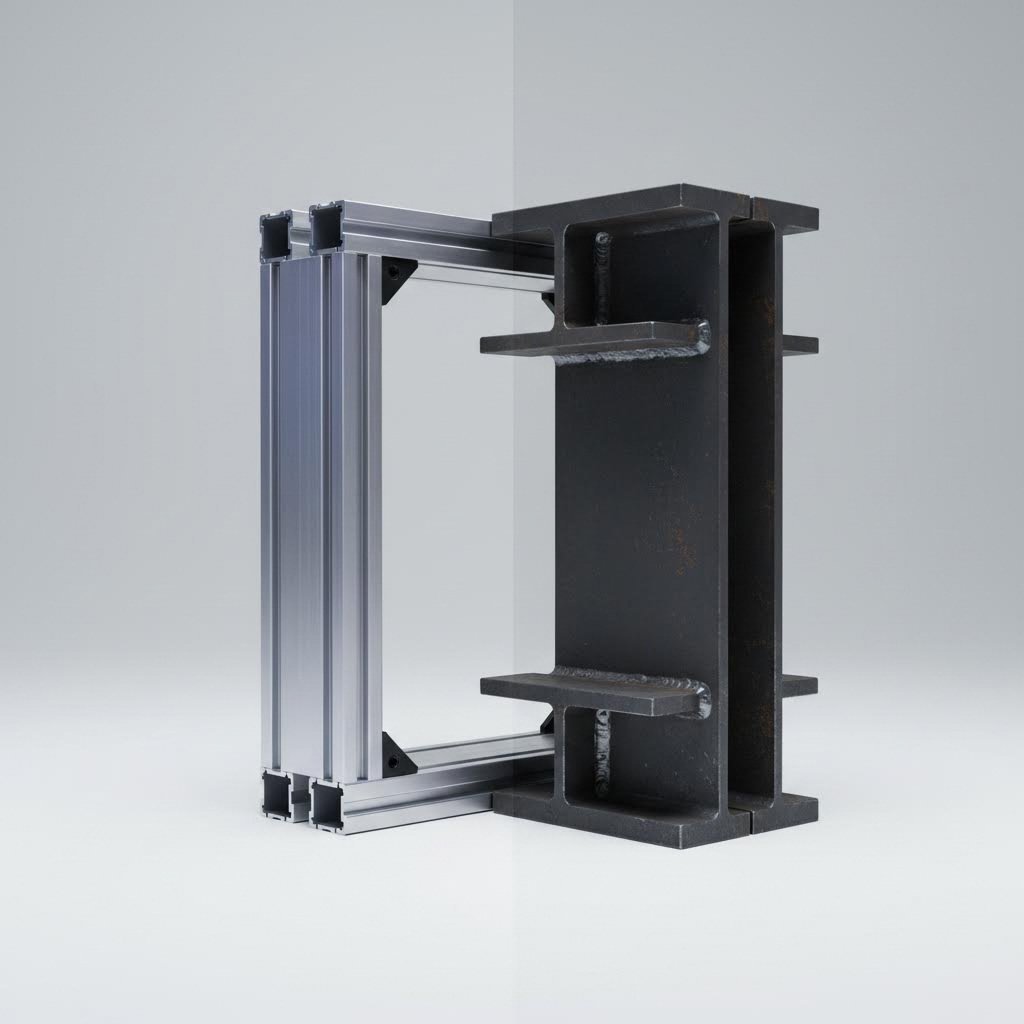
Now that you understand application-specific requirements, a bigger question often emerges: should you be using aluminum at all? Steel offers undeniable raw strength, and many engineers default to it for structural applications. But comparing alu 8020 systems to steel requires looking beyond simple tensile strength numbers - the complete picture reveals why aluminum dominates so many framing applications despite steel's apparent advantage.
Let's address the obvious first: steel is stronger than aluminum in absolute terms. According to AngleLock's engineering analysis, common structural aluminum grades offer 30,000-40,000 psi yield strength, while structural steel typically delivers around 50,000 psi. On paper, steel wins.
But here's what those raw numbers miss: aluminum weighs roughly one-third as much as steel. This weight difference transforms the strength comparison entirely. When you factor in density, aluminum 80 20 framing systems can provide up to twice the strength of steel frames at equivalent weight. This strength-to-weight advantage explains why aerospace, automotive, and countless industrial applications have embraced aluminum despite steel's higher absolute strength.
What does 80 20 aluminum mean for your project practically? Consider these real-world implications:
Stiffness presents another important comparison point. According to industry research, stiffness and deflection are proportional to thickness cubed. This mathematical relationship means aluminum frames with the same weight as steel frames can provide approximately three times the stiffness. For applications where deflection matters more than ultimate breaking strength - think precision equipment frames or vibration-sensitive installations - aluminum often outperforms steel despite lower raw strength numbers.
The best material for structural framing isn't always the strongest one - it's the one that delivers required performance at acceptable weight, cost, and maintenance burden for your specific application.
Despite aluminum's advantages, certain scenarios genuinely demand steel construction. Recognizing these situations prevents costly mistakes:
However, most workshop, automation, and light industrial applications fall well within aluminum's capabilities. The question isn't whether aluminum can work - it's whether you've selected the right profile size and connection system for your loads.
Strength comparisons often overlook a factor that matters enormously for long-term performance: corrosion resistance. According to 4K Aluminum's analysis, aluminum forms a natural oxide layer that protects against environmental degradation. This inherent corrosion resistance means aluminum framing requires minimal maintenance to maintain structural integrity over decades of service.
Steel tells a different story. Carbon steel readily rusts in humid, marine, or chemically aggressive environments. According to industry sources, painting or galvanizing welded steel before use is essentially mandatory. These protective treatments add cost, require periodic maintenance, and eventually fail - exposing the underlying steel to corrosion that weakens the structure.
Surface treatments can enhance aluminum's already-excellent durability even further:
For outdoor structures, humid environments, or applications involving water exposure, aluminum's corrosion resistance often outweighs steel's strength advantage. A structure that maintains full strength after twenty years of outdoor exposure delivers more value than one requiring continuous maintenance - or replacement - due to rust damage.
The material selection decision ultimately comes down to matching requirements to capabilities. For most framing applications - from workstations to automation equipment to enclosures - properly sized aluminum extrusion delivers the strength you need at lower weight, reduced maintenance burden, and competitive cost. Steel remains the right choice for truly heavy-duty applications, high-temperature environments, and building-scale construction. Understanding where each material excels helps you make the selection that serves your project best.
You've explored the technical specifications, compared profile sizes, and evaluated aluminum against steel alternatives. But here's something many builders overlook until it's too late: not all 2020 aluminium extrusion is manufactured equally. The numbers we've discussed throughout this guide - tensile strength, load capacity, deflection limits - assume you're working with quality material produced under controlled conditions. Manufacturing inconsistencies can undermine even the most carefully engineered design.
When sourcing aluminum extrusion 2020 profiles for structural applications, several quality indicators separate reliable suppliers from those cutting corners. Understanding these factors helps you avoid frustrating discoveries mid-project - like profiles that won't mate properly or material that falls short of expected strength.
Process control during extrusion matters as much as inspection afterward. Precise management of billet temperature, ram speed, exit temperature, and cooling rate determines whether finished profiles achieve consistent dimensions and acceptable mechanical properties. According to industry quality standards, real-time monitoring helps identify deviations before they affect the finished product - a practice that distinguishes premium manufacturers from commodity suppliers.
Beyond basic quality control, working with experienced suppliers unlocks capabilities that can transform your project outcomes. The difference between ordering commodity profiles and partnering with a full-service aluminum specialist becomes apparent when you need more than standard lengths off the shelf.
Consider what comprehensive aluminum processing services can offer:
For projects requiring custom 6063 aluminum profiles or complex industrial extrusions, suppliers offering end-to-end support from die development through mass production dramatically simplify procurement. Shengxin Aluminium, for example, brings over 30 years of industry experience to comprehensive aluminum extrusion and deep processing services. Their facility houses 35 advanced extrusion presses ranging from 600T to 5500T capacity, paired with state-of-the-art CNC machining centers capable of precise cutting, drilling, and bending to exact specifications.
This integrated approach offers distinct advantages for structural projects:
As you move from planning to procurement, keep these principles in mind:
Understanding how strong 2020 aluminum extrusion profiles are gives you the foundation for successful structural projects. But translating that knowledge into real-world results requires quality materials, proper connections, and application-appropriate design decisions. Whether you're building a precision 3D printer frame, an industrial automation system, or custom workstation equipment, matching your profile selection to actual requirements - then sourcing from suppliers who deliver consistent quality - ensures your finished structure performs exactly as intended.
2020 aluminum extrusion offers tensile strength between 185-310 MPa depending on the alloy. 6061-T6 provides approximately 45,000 psi tensile strength with 40,000 psi yield strength, while 6063-T5 delivers around 27,000 psi tensile strength. At a 500mm span, a standard 2020 profile can support approximately 99 N (10 kg) as a horizontal beam before exceeding acceptable deflection limits.
Aluminum extrusion strength varies by alloy and profile size. Standard alloys like 6005-T5 offer 37,700 psi tensile strength, while 6061-T6 reaches 45,000 psi. The profile's moment of inertia significantly impacts practical load capacity - larger profiles like 4040 provide approximately 12 times the bending resistance of 2020, despite only doubling in dimensions.
Load capacity depends heavily on span length and orientation. A 2020 profile at 300mm span holds approximately 17 kg (37 lbs), dropping to 10 kg (22 lbs) at 500mm and only 2.4 kg (5.3 lbs) at 1000mm spans. Vertical columns handle significantly higher compression loads. Applying a 3:1 safety factor for structural applications is recommended.
Choose 2020 for horizontal spans under 400mm, light-duty enclosures, cable management, and sensor mounts. Upgrade to 2040 when spans exceed 400mm or loads require 7x the strength. Select 4040 for primary structural members, CNC machines, or applications demanding 12x the rigidity of 2020 profiles.
Four main factors determine strength: alloy type (6061-T6 vs 6063-T5), cross-sectional geometry and wall thickness, T-slot configuration, and connection methods. Importantly, joints are typically weaker than the extrusion itself - proper brackets, T-nuts torqued to 3-5 Nm, and gusset reinforcement significantly impact overall assembly strength.



 خدمة الإنترنت
 0086 136 3563 2360
 sales@sxalu.com
 +86 136 3563 2360
 العربية
 English
 français
 Deutsch
 русский
 español
 português
 ไทย
ไทย Việt
Việt Українська