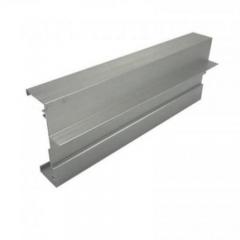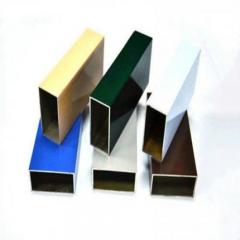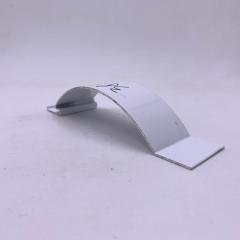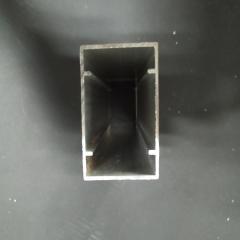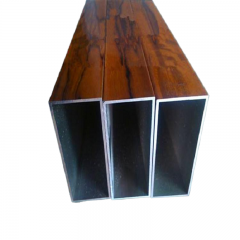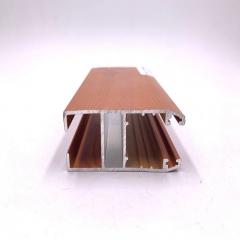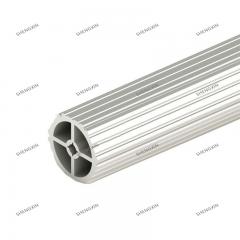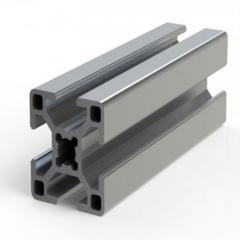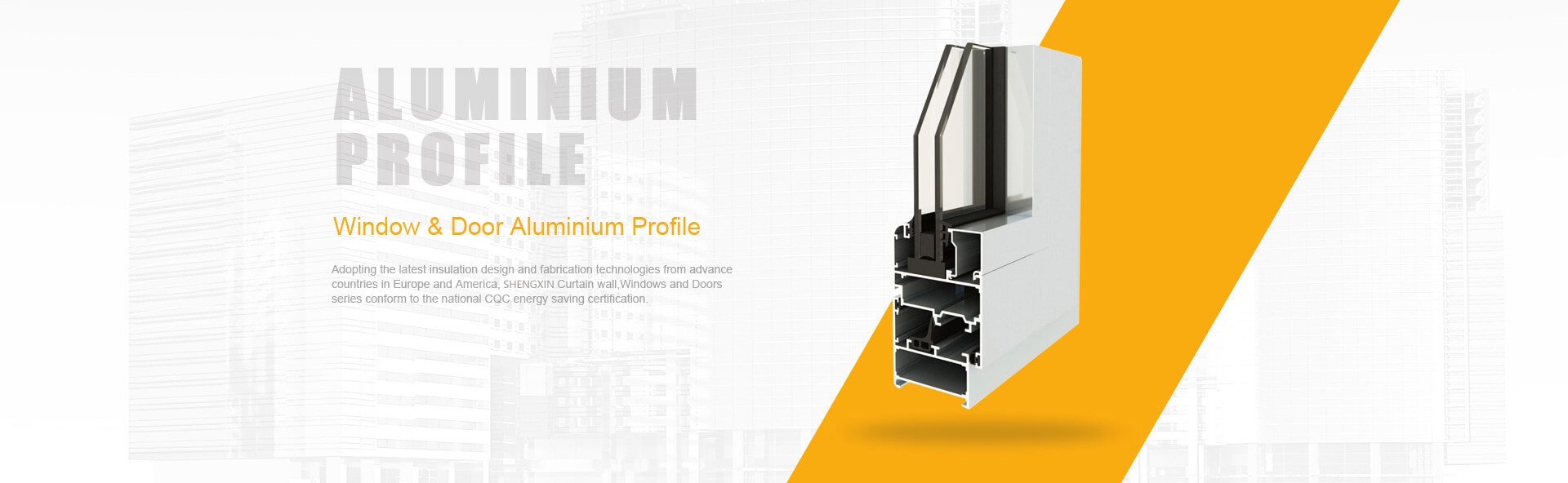
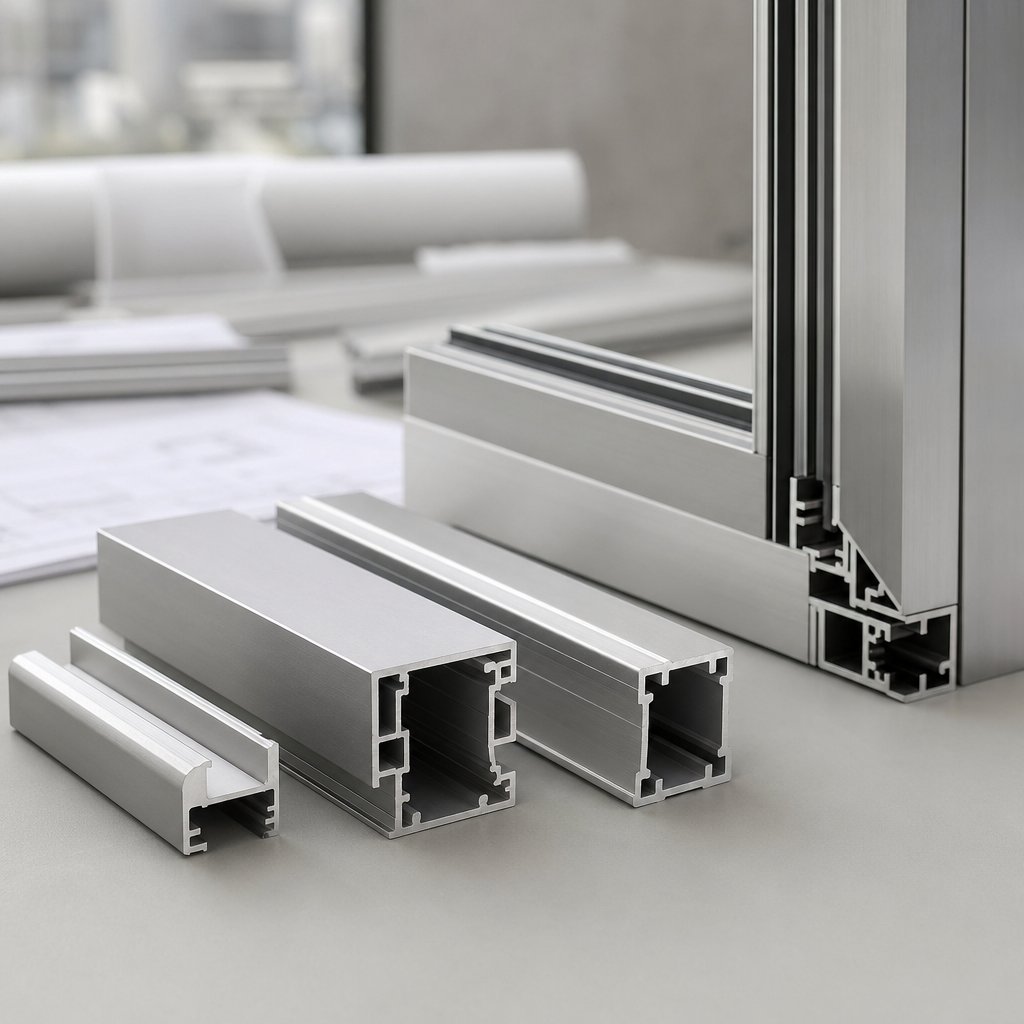
If you search for an aluminum frame profile, you can end up in three very different product categories. That confusion causes a lot of bad quotes and wrong-part orders. In simple terms, a frame profile is a shaped aluminum extrusion intended to become one member of a frame. It is narrower than the general term "aluminum profile," which can also mean angles, tubes, channels, trims, or other extrusions that are not frame members. It is also different from a finished frame system, which includes the profile plus the hardware, seals, panels, glazing parts, and fasteners needed for assembly.
An aluminum frame profile is an extruded aluminum section designed to form part of a frame. By itself, it is a component, not a complete assembled system, and it is not a catch-all name for every aluminum extrusion shape.
Think of the profile as the shaped building block. In a modular aluminum profile frame, the extrusion provides the structural edges and connection surfaces. In architectural work, the profile may include pockets for glass, seals, and hardware. Window framing basics also make an important distinction: the fixed frame and the moving sash are different parts. So aluminum door frame profiles usually refer to the extruded sections that form those perimeter members, not the full installed door set.
The split is not just cosmetic. Industrial vs architectural guidance shows that industrial profiles prioritize strength, rigidity, machining compatibility, and tight assembly tolerances. Architectural sections put more emphasis on appearance, outdoor durability, and stable installation. That is why their hardware differs too: industrial members often use brackets, slot nuts, and joining plates, while architectural aluminum frame profiles work with hinges, locks, anchors, gaskets, and glazing beads.
| Context | Typical geometry | Hardware compatibility | Common end uses |
|---|---|---|---|
| Modular industrial framing | Square or rectangular structural sections, often with side grooves and center bores | Brackets, end fasteners, plates, feet, panel retainers | Machine frames, workstations, guards, carts |
| Slot or groove systems | Profiles with open or closed grooves for accessories and infill | T-nuts, groove nuts, slot covers, panel inserts | Reconfigurable assemblies, lean lines, light enclosures |
| Architectural door and window framing | Chambered sections with glazing pockets, seal lands, and visible faces | Glazing beads, hinges, locks, anchors, gaskets | Windows, doors, storefronts, facade framing |
Those categories can all be called a frame profile, but their shapes, grooves, and assembly logic are far from interchangeable. Geometry is where the differences become obvious, and that is exactly where profile families start to matter.
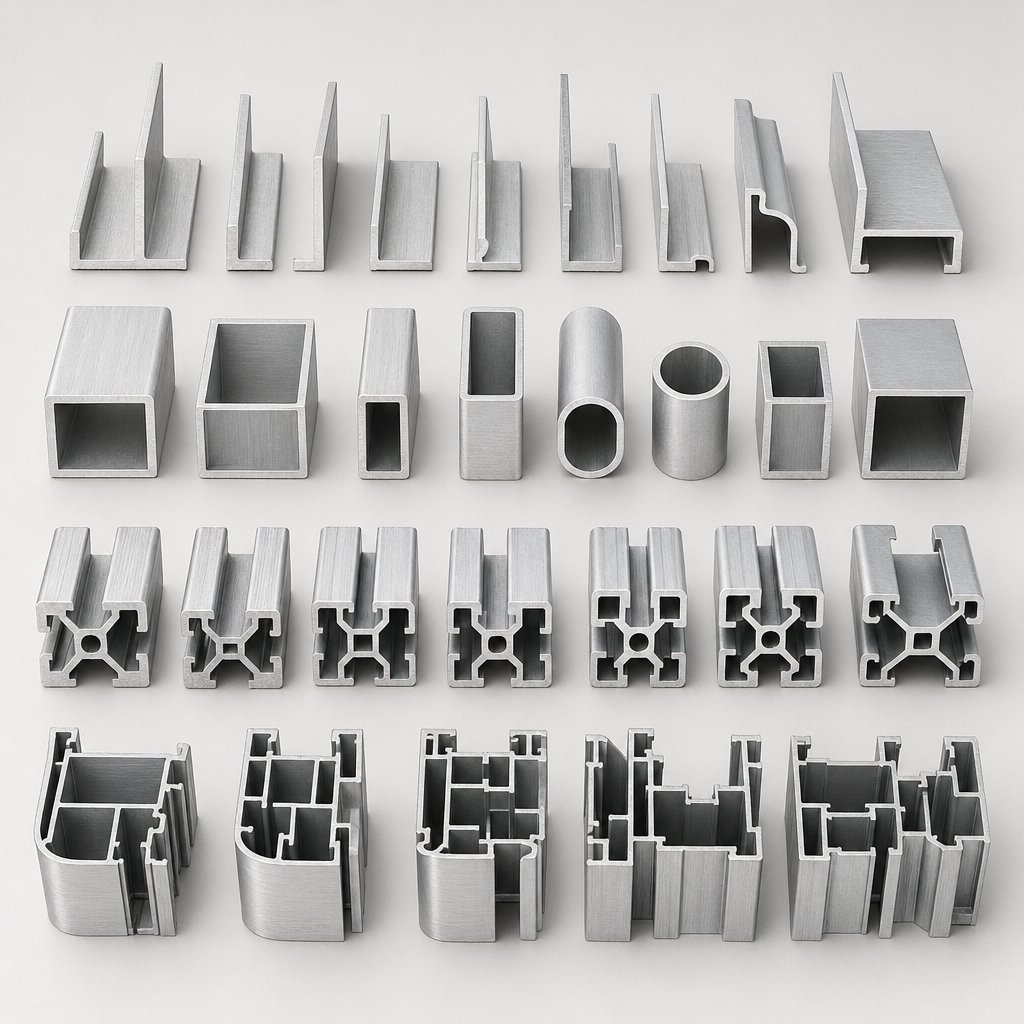
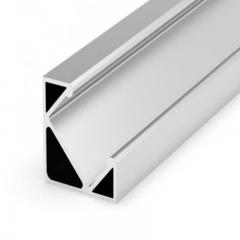
A quick look at the cross-section usually tells you what a profile is meant to do. Most aluminum frame extrusion profiles fall into a few geometry families. Some are open shapes, such as U, L, T, and H sections, used for edges, corners, connectors, or glass support. Others are closed or hollow shapes, such as square and rectangular sections, which a window profile guide notes are common where lower weight and structural support both matter. Simple shapes can work well in basic frames, but slots, grooves, and internal chambers are what turn an extrusion into a system part.
In practice, most families break down into four broad groups. First are open sections, which are easy to use for edge capture, corner transitions, and connectors. Second are closed or hollow sections, often used as straightforward perimeter members or reinforcements. Third are modular framing members with continuous side grooves for hardware. Fourth are chambered architectural sections, where one profile may need to hold glass, seals, drainage paths, and moving hardware at the same time. That last category is why window and door members rarely resemble shop-built machine frames.
The split between T-slot and V-slot is more than a naming issue. A T-slot vs V-slot guide shows that T-slot profiles use T-shaped grooves sized for T-nuts, bolts, and brackets. They are favored for modular frames, workstations, shelving, and other static structures because they combine strong load support with easy reconfiguration. When someone searches for a t slot aluminum profiles extrusion frame, they are usually describing that kind of build.
An aluminum profile v extrusion frame points to a different job. V-slot profiles use a V-shaped groove that works with V-wheels, so the profile also acts as a motion path. That makes them a better fit for CNC machines, 3D printers, robotic arms, and similar equipment where smooth travel and alignment matter. Searches for aluminum profiles vslot extrusion frame usually relate to that motion-focused use, not to heavy benches or guarding.
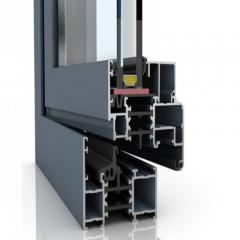
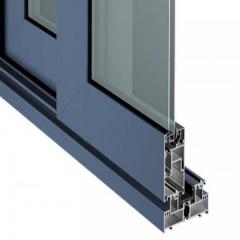
Architectural members follow a different assembly logic. Aluminum window frame extrusion profiles often use multiple chambers, glazing pockets, and gasket grooves instead of a universal side slot. Casement profiles are shaped for hinges and locking points. Sliding profiles may use two-track or three-track runners for sash movement. Fixed, awning, bi-fold, pivot, and thermal break designs each change the cross-section because the profile has to manage glass support, weather sealing, and hardware integration together. Thermal break versions add a non-metallic polyamide barrier between inner and outer aluminum sections, which further changes the geometry.
| Profile family | Slot or groove format | Typical accessories | Strengths | Limitations | Best-fit applications |
|---|---|---|---|---|---|
| Open sections | No continuous fastening slot; open faces such as U, L, T, or H shapes | Corner joins, edge trims, glazing supports, simple fasteners | Simple geometry, easy edge support, useful for connectors | Less modular than slotted systems | Glass retention, edging, connectors, light frame details |
| Closed or hollow sections | Usually no external slot; enclosed square or rectangular cavities | Welded or mechanically joined connectors, plates, reinforcement parts | Good structural efficiency with reduced weight | Less convenient for add-on accessories without machining | Basic frames, reinforcements, simple structural members |
| T-slot profiles | Continuous T-shaped groove | T-nuts, bolts, brackets, joining plates, panel retainers | High load support, modularity, easy modification | Not designed as a precision wheel track | Workstations, enclosures, machine bases, shelving |
| V-slot profiles | Continuous V-shaped groove | V-wheels, motion components, selected fasteners | Smooth linear motion, precise guidance, modular layout | Moderate load capacity and tighter alignment needs | CNC machines, 3D printers, robotics, light automation |
| Chambered architectural sections | Glazing pockets, gasket grooves, hardware cavities, sometimes thermal break channels | Glazing beads, EPDM seals, hinges, locks, rollers, corner brackets | Supports glass, sealing, drainage, and finished appearance in one profile | Less universal across systems; hardware is profile-specific | Windows, doors, curtain wall related assemblies, weather-exposed framing |
Two profiles can look similar from the outside and still behave very differently once wall layout, chamber count, and groove design change. That is where catalog specs stop being background detail and start deciding whether a frame goes together cleanly or comes back for rework.
A cross-section shows what a profile can do, but the datasheet shows how well it will do it. When two aluminum frame profiles look similar, differences in alloy, temper, wall layout, and finishing often decide whether the part stays straight, machines cleanly, and lasts outdoors. That matters in a modular aluminum profile frame structure and even more in an aluminum profile for window frames, where glass, seals, wind, and temperature swings all work on the same member.
Metal choice matters, but geometry and wall design often matter just as much for stiffness, fit, and service life.
Catalogs can make thicker sound automatically better. It is not that simple. Yaji lists 1.2 mm as a common residential window profile thickness and 1.4 to 1.6 mm for more demanding conditions, while HTS shows that some door and external frame sections are built thicker. The practical lesson is to compare thickness within the same profile family and application, not across unrelated systems.
Temper affects strength and workability at the same time. T5 is often a balanced choice for architectural use, while T6 suits cases where higher strength is worth a bit less forming flexibility. Tolerance belongs in the same conversation. A slightly oversized groove, an off-center chamber, or a bowed length can turn an aluminum profile extrusion frame into site trimming and alignment problems. In aluminum profiles extrusion frame systems, small dimensional misses stack up fast.
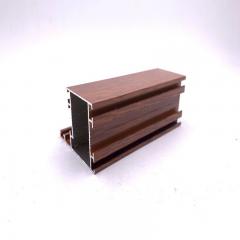
Finish is not only about color. Yaji describes anodizing as a way to thicken the natural oxide layer for better corrosion resistance and surface hardness, while powder coating adds a durable cured layer suited to outdoor exposure. HTS also lists electrophoretic coating, PVDF, and wood grain transfer for projects with specific visual or weathering needs.
Thermal break design matters just as much in architectural work because aluminum conducts heat readily. Both references describe a barrier between inner and outer sections that lowers heat flow and helps limit condensation. If the profile will carry glass, panels, or hardware, those specs stop being abstract numbers. They become the reason connectors fit, gaskets seal, and the frame goes together without rework.
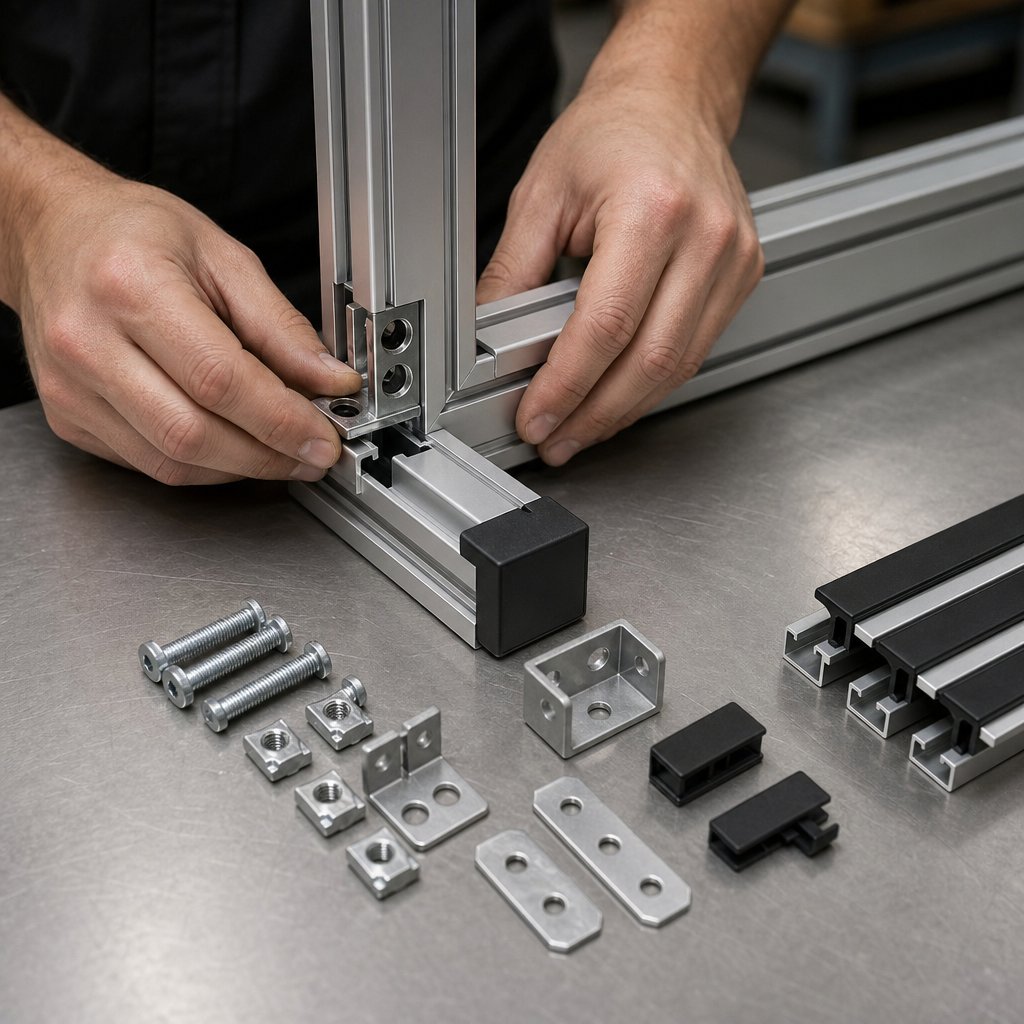
A well-chosen profile can still fail in practice if the jointing method is treated like an afterthought. In modular systems, the slot is more than a shape in the extrusion. It is the mounting point for nuts, bolts, brackets, plates, and later add-ons. AngleLock emphasizes that this hardware is what gives aluminum framing much of its flexibility, especially when a structure may need changes after initial assembly. That is why connector planning should happen alongside profile selection, not after the cut list is finished.
T-nuts create the threaded anchor inside the slot. A bolt passes through a bracket, plate, or accessory and tightens into that nut, pulling the parts together. The same source notes that sliding T-nuts are a sturdy choice for mounting and support, while drop-in T-nuts are useful when you need to add hardware after assembly without taking the frame apart. In searches for an aluminum profiles v slot extrusion frame, this same rule still applies: the nut style and fastener format must match the groove before you order hardware. AngleLock also distinguishes bolts from screws. Bolts work with nuts and suit stronger joints, while screws are faster for lighter attachments.
Compatibility is where many mistakes begin. Plate hole patterns, nut style, slot width, and connector geometry all have to match the profile family. The same caution applies to an aluminum profile frame door, where infill-retention parts are usually profile-specific rather than universal.
Most costly rework starts inside this sequence, not after it. A missed nut, the wrong bracket, or an unchecked corner can turn a simple build into field adjustment. The profiles that perform best are the ones whose connectors and accessories also fit the loads, enclosure needs, and exposure conditions they will face.
A profile that works perfectly on a machine base can be a poor fit for a storefront, rooftop array, or HVAC cabinet. Real applications change the priorities fast. Span, load, weather, finish, hardware fit, and future modifications all shape the right choice. That is why the best way to select an aluminum frame profile is to start with the job it must do, not just the cross-section drawing.
Exterior openings ask a lot from a frame. The door and window guide highlights climate, profile thickness, surface treatment, and thermal insulation as key checks. For an aluminum door frame profile, weather exposure and hardware compatibility matter just as much as basic strength. For an aluminum window frame profile, seal support, drainage design, and in many cases thermal-break construction deserve close attention too.
Finish should match the setting. The same guide notes that anodized surfaces improve corrosion and wear resistance, while powder coating adds color flexibility and strong outdoor UV performance. Wood grain transfer can be useful when appearance is part of the brief. Large sliding openings raise the stakes further. Aluminum patio door frame profiles usually need straighter, more stable sections that can support wider spans, work cleanly with sliding hardware, and keep their finish under sun, rain, and frequent use.
Industrial structures reward a different selection logic. Machine guards, workstations, conveyors, plant safety structures, and equipment enclosures often need panel mounting, brackets, and later changes. In those cases, slotted or grooved members are often easier to live with because accessories can be added or moved without rebuilding the whole frame. Simpler hollow sections can still suit fixed builds, but they give you less room to adapt when requirements shift.
Some projects are much lighter duty. An aluminum frame profile led panel or an aluminum profile led panel frame usually cares more about clean edges, cover retention, and visual finish than about heavy load or long unsupported span. HVAC-related frames sit in the middle. An air conditioning unit frame aluminum profile or an air handling unit ahu frame aluminum profile often benefits from secure panel attachment, access-friendly joints, and finishes that handle condensation, cleaning, and occasional corrosive exposure.
Application-based selection gets easier when you check five things together: load, span, enclosure needs, reconfiguration, and exposure. Even the application groupings shown in profile categories separate architectural, industrial, LED, and solar uses, which is a useful reminder that one family rarely fits every project.
| Application | Typical environmental demands | Connection needs | Finish considerations | Profile traits to prioritize |
|---|---|---|---|---|
| Doors and windows | Rain, sun, temperature swings, and in some regions salt-laden air | Glazing, gaskets, hinges, locks, anchors, and stable corner joining | Anodized, powder coated, or wood grain finishes depending on exposure and design intent | Chambered geometry, seal support, drainage logic, hardware compatibility, and thermal-break options where energy performance matters |
| Patio doors and large glazed openings | Outdoor exposure plus repeated sliding or opening cycles | Rollers, runners, corner joints, and reliable glass retention | Durable outdoor finish with good corrosion resistance | Straightness, corner stability, wider-span capability, and profile shapes designed around sliding hardware |
| Industrial enclosures and machine guards | Indoor wear, vibration, panel changes, and occasional washdown | Brackets, slot nuts, panel retainers, access-door hardware | Choose finishes for cleanability and shop conditions rather than appearance alone | Grooved or slotted members, easy accessory mounting, repeatable squareness, and practical reconfiguration |
| Workstations, conveyors, and plant safety structures | Frequent accessory additions, impact risk, and evolving layouts | Guards, shelves, signs, feet, braces, and modular attachments | Match finish to indoor use, cleaning frequency, or corrosive surroundings | Rigidity over the required span, modular connection faces, and simple field adjustment |
| HVAC-related frames | Condensation, cleaning chemicals, mechanical service access, and sometimes rooftop exposure | Panel fastening, removable covers, service doors, and equipment mounts | Moisture-conscious, corrosion-resistant surface choices are important | Profiles that stay square, support infill panels well, and resist moisture-related durability issues |
| Solar framing and related supports | Continuous outdoor exposure, transport handling, and long service expectations | Corner connections, mounting holes, and secure attachment to the broader assembly | Corrosion-resistant finishes are critical outdoors | Low weight, corrosion resistance, stable corners, and durable geometry suited to exposed installations |
| LED panel and light-duty trim frames | Mostly indoor use with high visual expectations | Cover retention, neat miters, and light infill support | Appearance and surface consistency are often top priorities | Clean visible faces, light-duty geometry, and good fit for covers or diffusers |
Solar projects show why context matters so much. The solar mounting guide notes that solar modules commonly use aluminum frames because the panel assembly includes brittle tempered glass and needs protective framing. The same source also points to low weight, corrosion resistance, and convenient corner-code assembly as practical advantages. So when reviewing aluminum profiles for solar panel frame use, outdoor durability and secure corner construction usually matter more than the easy reconfiguration prized in a shop workstation.
The pattern holds across every category in the table. Match the section to the environment and the system around it, not to the drawing alone. Even then, the right geometry does not automatically settle the bigger question, because some projects still need a hard look at whether aluminum is the best material choice at all.
Profile geometry gets most of the attention, but base material still shapes weight, upkeep, thermal behavior, and lifespan. A practical material comparison shows why aluminum is often favored for modern framing, while steel, uPVC, and wood remain better fits in some structural, aesthetic, or budget-led jobs.
Aluminum offers a strong strength-to-weight balance, so it can support large glazed areas with relatively slim visible sections. It also resists corrosion well and, when powder coated, needs little routine maintenance. Those are some of the real advantages of industrial aluminum profile frames, especially in enclosures, guards, and modular structures that may need to stay clean, rigid, and easy to rework. The same appeal carries into visible applications such as an aluminum glass frame profile or some aluminum picture frame profiles, where crisp lines and low upkeep matter.
Steel can be the stronger choice for very high-load, security-focused, or heritage-style projects that want ultra-slim sightlines and do not mind extra weight or corrosion protection. uPVC usually makes more sense in standard window work where first cost and thermal insulation lead the decision. Wood still fits projects that value natural warmth, repairability, and traditional detailing. For a decorative aluminum mirror frame profile, aluminum may suit wet spaces better, but wood can deliver a softer visual character. In other words, the advantage of using an industrial aluminum profile frame disappears if modularity and low maintenance are not the real priorities.
| Material | Typical strengths | Common drawbacks | Best-fit applications |
|---|---|---|---|
| Aluminum | Lightweight, corrosion resistant, low maintenance, slim profiles, recyclable | Higher upfront cost than uPVC, needs thermal break in building-envelope use | Modern windows, doors, outdoor frames, modular industrial systems |
| Steel | Very high strength, narrow sightlines, strong security, long life with protection | Heavier, usually costlier, needs corrosion control | Historic work, security-focused openings, high-strength custom frames |
| uPVC | Good insulation, low cost, weather resistant, low maintenance | Less suitable for very large spans, fewer premium finish options | Standard residential windows and budget-sensitive projects |
| Wood | Natural insulation, warm appearance, repairable, traditional appeal | Higher maintenance, moisture sensitivity, periodic refinishing | Traditional homes, restoration work, decorative interior frames |
Choose for environment, span, maintenance burden, and lifecycle value, not unit price alone.
No material wins every project. Aluminum is often the smart choice for low-maintenance outdoor use and reconfigurable systems. Steel may lead when strength or historic character dominates. uPVC can win on cost and insulation. Wood can win on appearance. That choice sets the baseline, but manufacturing quality still decides whether the delivered profile actually performs the way the material promises.
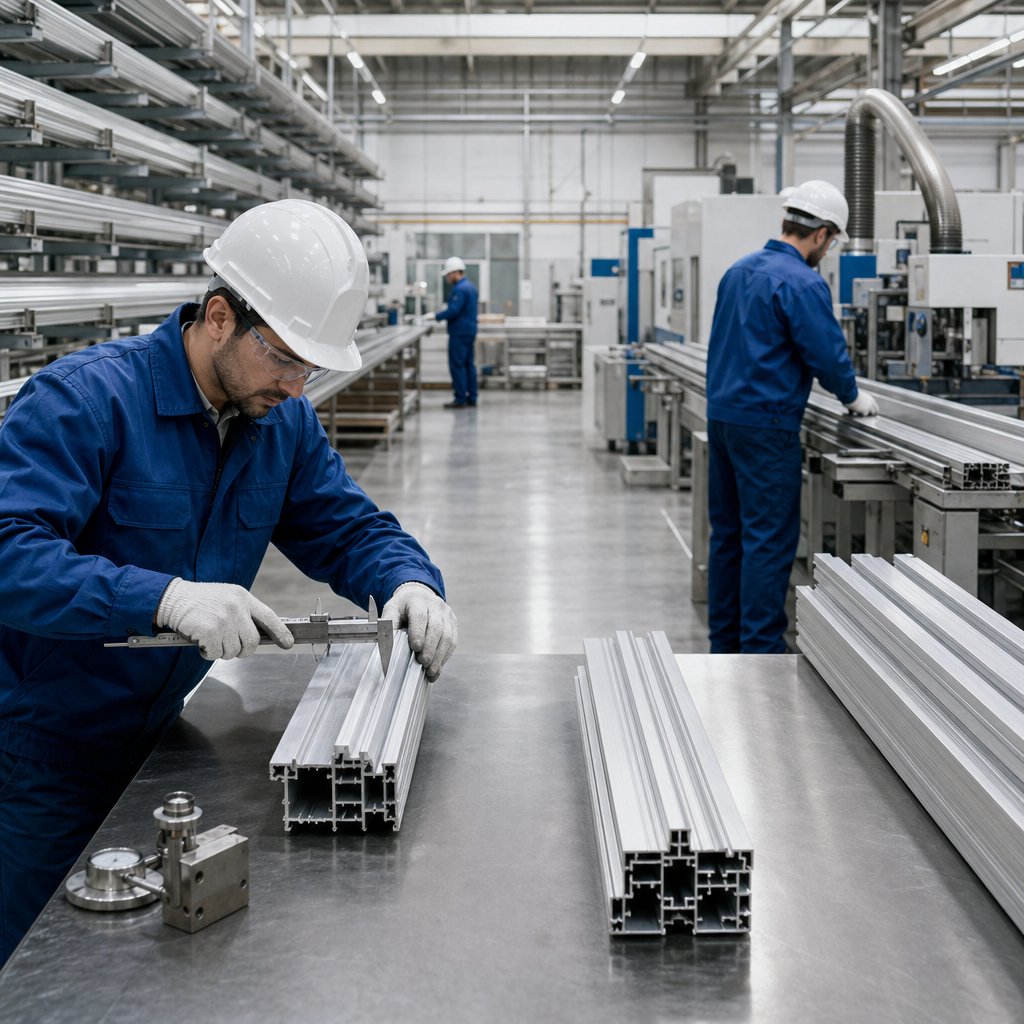
Material choice sets the baseline, but manufacturing capability decides whether the delivered section actually matches the drawing. Rework often starts when a supplier misses tolerances, finish consistency, or delivery timing. For architects, fabricators, and procurement teams, the safer filter is not the lowest quote. It is whether the source can show repeatable extrusion, inspection, customization support, and dependable capacity.
Ask direct questions. Do you build to ISO, ASTM, or EN requirements for this product family? Can you provide material certifications and lot traceability? How do you inspect critical dimensions and surface finish? What is the process for custom dies, samples, and finish approval? If you are comparing aluminum frame profile suppliers for architectural work, also ask how they support anodizing, electrophoretic coating, or powder coating across repeat orders.
Reliable architectural production shows up in both specialization and scale. A capable aluminum window frame profile manufacturer should be able to discuss custom profiles, finish options, quality control, and production capacity without vague answers. For example, Shengxin Aluminum presents 30 years of manufacturing experience, advanced extrusion technology, and 60,000-ton annual production capacity for architectural profiles. That does not replace due diligence, but it is the kind of verifiable signal buyers should look for when narrowing aluminum frame profile suppliers. A strong shortlist makes final quote review much clearer, because by then you are comparing fit and risk, not just price.
A shortlist only helps if it turns into a cleaner spec and a better quote request. By this stage, the biggest risk is no longer confusion about profile types. It is ordering a section that looks right on paper but does not fit the hardware, finish, tolerance, or environment your project actually demands. That is especially true when an aluminum window and door frame profile is being compared against industrial members that use a very different assembly logic.
The best aluminum frame profile is the one that matches system requirements, not the one with the lowest line-item price.
If your project is architectural, start with a specialist resource such as Shengxin Aluminum when comparing high-end window profile options. For broader selection questions, the Khetan checklist and the PTSMAKE guide are useful for reviewing requirements, finish choices, and supplier questions. When you contact aluminum profile frame suppliers, treat a specialist aluminum window frame profile factory differently from general-purpose extruders, and ask both to prove fit, finish, and process control before release.
An aluminum frame profile is an extruded section made to serve as one part of a frame, not a complete finished system. That distinction matters because many buyers confuse a single profile with a full assembly that also includes connectors, seals, glazing parts, and hardware. In practice, the term can point to modular industrial framing, slot-based framing members, or architectural door and window sections, so the intended application should always be clarified before comparing products.
T-slot profiles are mainly built for fastening and reconfiguration. Their grooves accept T-nuts, bolts, and brackets, which makes them a strong choice for workstations, machine frames, guards, and enclosures. V-slot profiles also support assembly, but their groove shape is intended to guide wheels, so they are more closely tied to motion-focused builds such as light automation, CNC equipment, and similar systems where smooth travel matters.
The most useful specs are alloy, temper, wall design, dimensional tolerance, finish, and, for building-envelope products, thermal break construction. Buyers often focus on thickness alone, but the internal geometry and how material is placed inside the section can affect stiffness and fit just as much. A good review also checks whether the finish suits the environment and whether hardware, glazing, or connector parts are designed for that exact profile family.
Choose architectural profiles when the frame must work with glass, gaskets, locks, hinges, drainage paths, and weather exposure. These sections are designed around sealing, appearance, and hardware integration, which is very different from the logic behind modular industrial members. If the job involves doors, windows, patio openings, or facade-related framing, profile-specific architectural sections are usually the safer route than trying to adapt general-purpose slotted framing.
Start by checking whether the supplier can consistently extrude the profile type you need, hold the required tolerances, and offer the right finish options. Then ask about customization support, inspection methods, traceability, and production capacity, because these factors directly affect rework risk and repeat-order consistency. For architectural projects, a supplier with clear manufacturing depth can be valuable; for example, Shengxin Aluminum highlights 30 years of experience, advanced extrusion capability, and large-scale capacity for window frame profiles, which are the kind of verifiable details buyers should look for when building a shortlist.



 خدمة الإنترنت
 0086 136 3563 2360
 sales@sxalu.com
 +86 136 3563 2360
 العربية
 English
 français
 Deutsch
 русский
 español
 português
 ไทย
ไทย Việt
Việt Українська