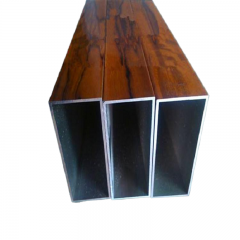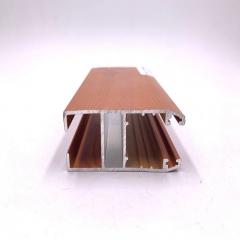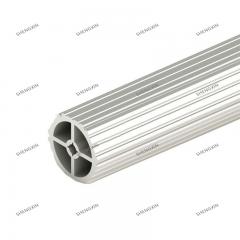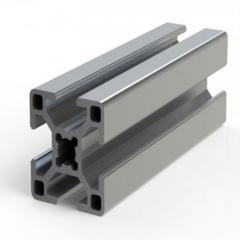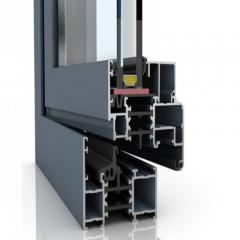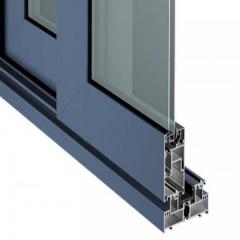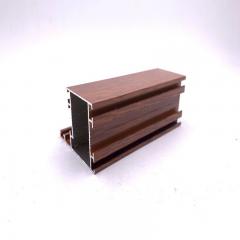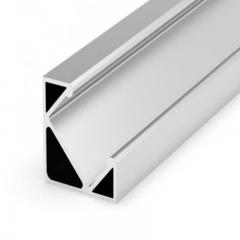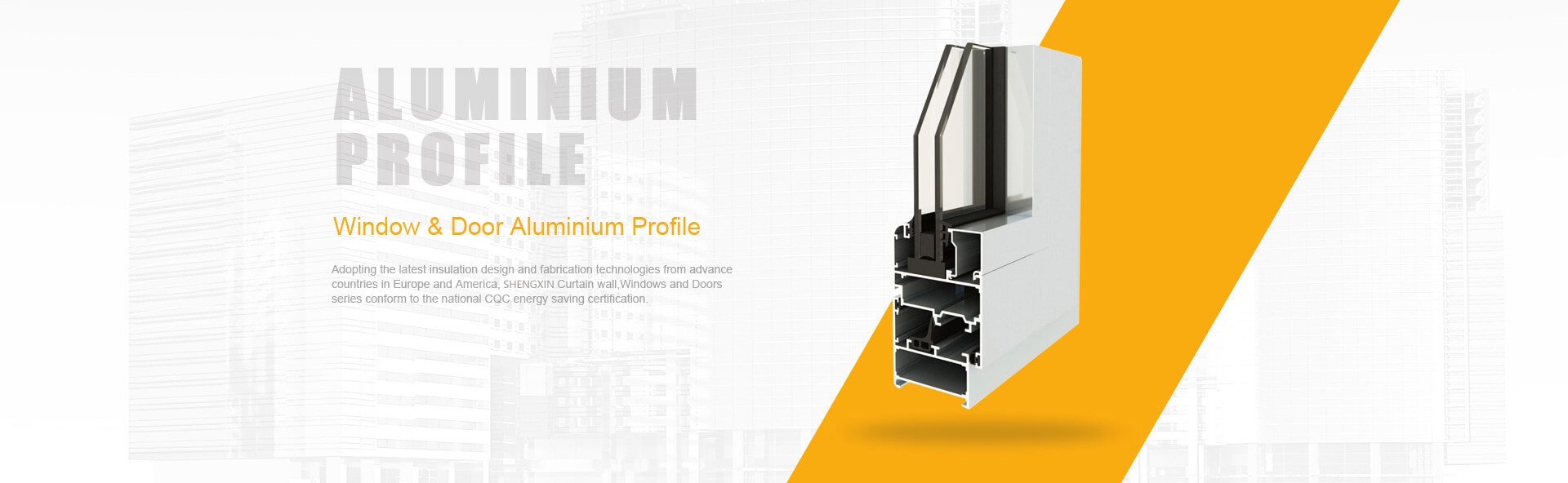
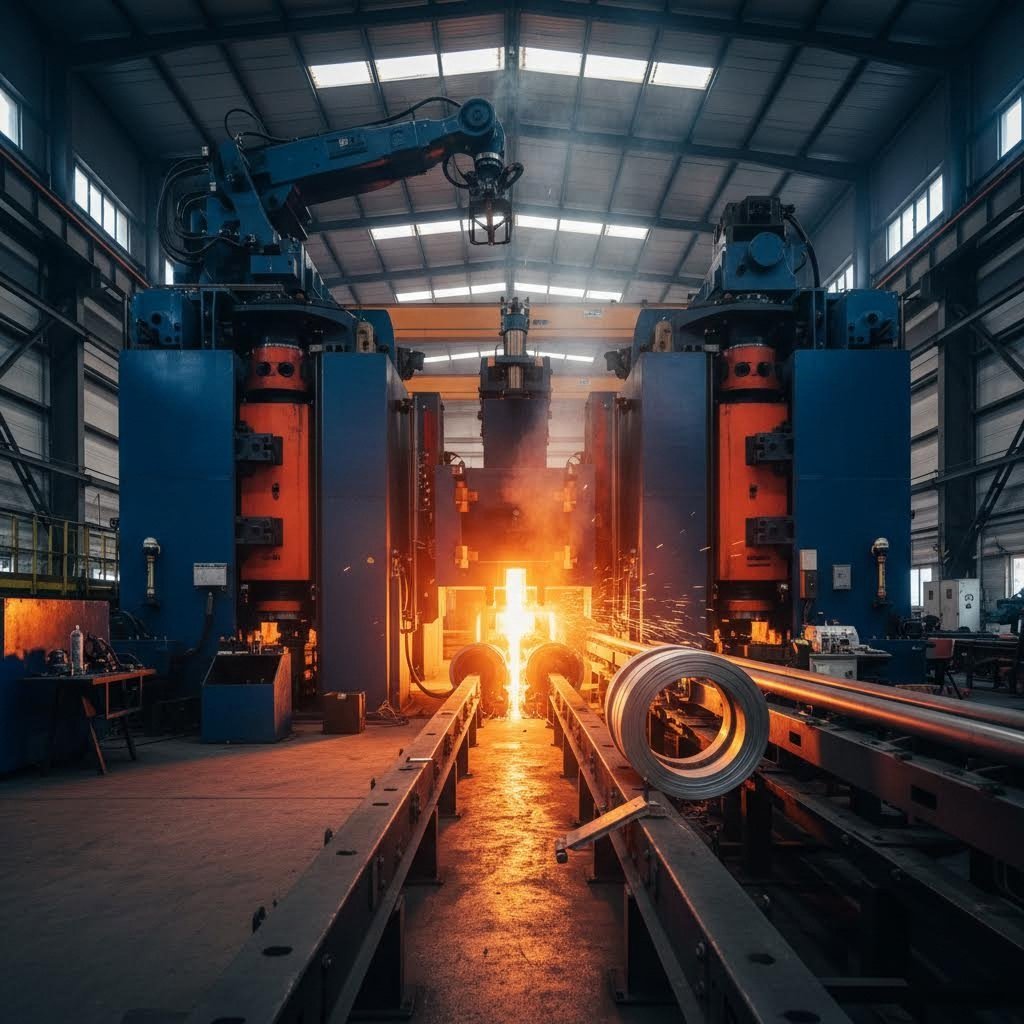
When you look around any modern building, vehicle, or electronic device, chances are you're seeing aluminum extrusions at work. This manufacturing process has quietly become one of the most important production methods in contemporary industry, shaping everything from window frames to automotive components. But what exactly makes this market so significant, and why are analysts projecting such substantial growth?
Simply put, aluminum extrusion is a manufacturing technique that transforms aluminum alloy into objects with specific cross-sectional profiles. Imagine squeezing toothpaste from a tube. The paste takes the shape of the opening as it emerges. Aluminum extrusion works on the same principle, just with heated metal and enormous hydraulic pressure.
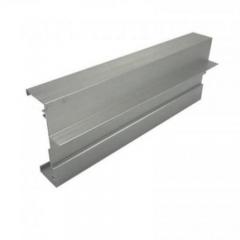
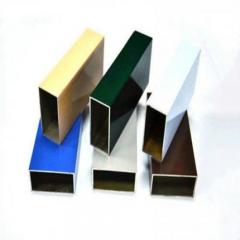
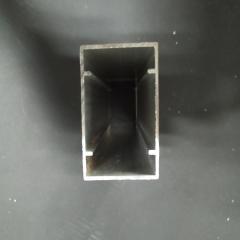
The resulting shapes can be solid, hollow, or semi-hollow. They can range from simple bars and tubes to incredibly complex architectural profiles. This versatility explains why extruded aluminum products appear across virtually every major industry sector.
The aluminum extrusion market has grown into a global powerhouse. According to Market Data Forecast, the industry was valued at approximately USD 88.53 billion in 2024 and is projected to reach USD 160.18 billion by 2033, growing at a CAGR of 6.81%. Other research firms project even higher valuations, with estimates ranging toward $169-198 billion by 2033-2035 depending on methodology and scope.
The increased use of aluminum extrusions in both traditional internal combustion vehicles and electric vehicles, combined with growing demand from construction and consumer products manufacturing, positions this market for sustained expansion through the next decade.
Understanding what aluminum extrusions are used for starts with understanding how they're made. The process begins with a cylindrical aluminum billet, typically measuring 6 to 8 inches in diameter. This billet gets heated to approximately 800-925°F (427-496°C), softening the metal to a malleable state without melting it completely.
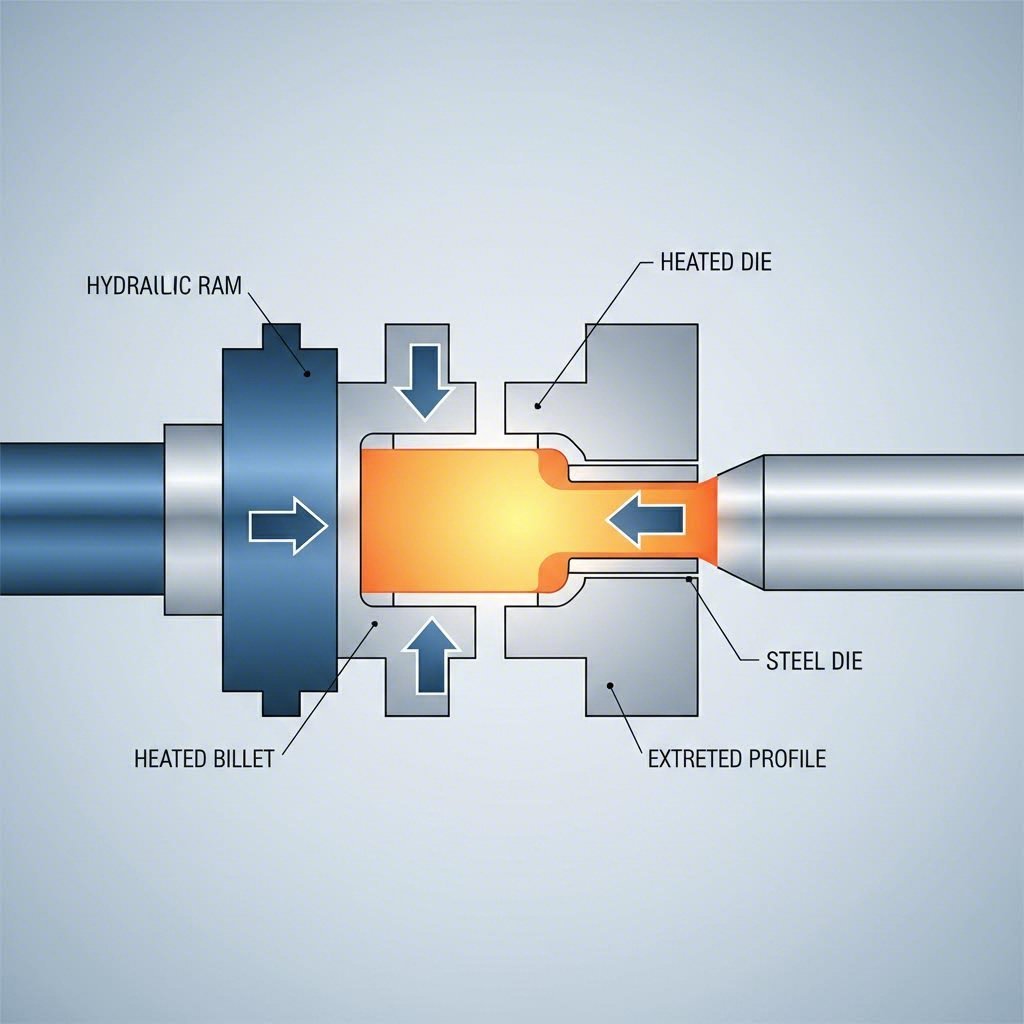
Next comes the extrusion itself. A powerful hydraulic ram forces the heated billet through a steel die, which contains an opening shaped exactly like the desired profile. The aluminum flows through this opening, emerging as a continuous length with the precise cross-section specified by the die design.
These extruded profiles typically come out in lengths of 8-24 feet. But the process doesn't stop there. According to Gabrian, profiles can then undergo several additional steps:
For example, untreated 6061 aluminum has a tensile strength of 241 MPa. After heat treatment to T6 temper, that same alloy reaches 310 MPa. This flexibility in properties makes the aluminium extrusion definition extend beyond just shaping metal. It encompasses a complete manufacturing system for creating precision components.
Whether you're an investor evaluating market opportunities, a procurement professional sourcing suppliers, or an industry analyst tracking sector trends, understanding these fundamentals provides the foundation for deeper market intelligence. The sections ahead will explore technical specifications, regional dynamics, and practical guidance for navigating this evolving industry.
Now that you understand what aluminum extruding involves at a basic level, let's dig deeper into the technical specifics that separate one extrusion method from another. These distinctions matter enormously when you're specifying high-performance aluminum extrusions for industrial applications or selecting the right alloy for structural aluminium extrusions.
Not all extrusion processes work the same way. The two primary methods, direct and indirect extrusion, each offer distinct advantages depending on your application requirements.
Direct extrusion is the most common process in the industry. Here's how it works: a hydraulic ram pushes the heated aluminum billet through a stationary die. The aluminum flows in the same direction as the ram travels. Sounds straightforward, right?
However, this simplicity comes with trade-offs. According to Hydro, friction develops between the billet and the container walls during direct extrusion. This friction increases the amount of work required during each press cycle, causing temperature to rise from the front to the rear of the extrusion. The result? Potential variations in metallurgical structure and dimensions along the profile length.
Indirect extrusion, sometimes called backward extrusion, flips the script. The ram carries the die and applies pressure onto a stationary billet, pushing in the opposite direction of the emerging extrusion. Since the billet doesn't move relative to the container, there's no billet-to-container friction.
The benefits of this approach include:
The trade-off? Indirect extrusion requires cleaner billets since surface contaminants can affect the finished profile. The die support mechanism also limits the maximum profile size compared to direct extrusion.
Beyond the direction of force, temperature plays a critical role in determining extrusion characteristics.
Hot extrusion operates with billets heated to 800-925°F (427-496°C). This elevated temperature softens the aluminum, reducing the force needed to push it through the die. Hot extrusion handles complex aluminum extrusion sizes and intricate cross-sections that would be impossible at lower temperatures. Most architectural, automotive, and industrial profiles use this method.
Cold extrusion occurs at or near room temperature. While requiring significantly more force, cold extrusion produces profiles with tighter tolerances, better surface finishes, and enhanced mechanical properties through work hardening. It's typically reserved for smaller, simpler shapes where precision matters most.
Some manufacturers also use warm extrusion, operating between these temperature extremes to balance formability with dimensional accuracy.
Selecting the correct alloy is just as important as choosing the right extrusion method. The aluminum alloy series, numbered from 1000 to 7000, each offer distinct properties tailored to specific applications.
According to JAX Manufacturing, the primary alloying elements define each series' characteristics. Understanding these differences helps procurement professionals and engineers make informed sourcing decisions.
| Alloy Series | Primary Alloying Element | Key Properties | Typical Applications | Relative Cost |
|---|---|---|---|---|
| 1000 | Pure Aluminum (99%+) | Excellent corrosion resistance, high thermal/electrical conductivity, superior workability | Electrical transmission lines, chemical equipment, decorative trim | Low |
| 3000 | Manganese | Good corrosion resistance, moderate strength, excellent formability | Beverage cans, roofing sheets, tubing, grating | Low-Medium |
| 6000 | Magnesium + Silicon | Good machinability, weldability, heat treatable, balanced strength | Architectural profiles, structural components, automotive parts, machinery frames | Medium |
| 7000 | Zinc (+ Magnesium, Copper) | Highest strength of all aluminum alloys, excellent mechanical properties after heat treatment | Aircraft landing gear, aerospace structural parts, high-stress components | High |
Within the 6000 series, which dominates the extrusion market, several alloys deserve special attention. Fonnov Aluminium notes that 6063 alloy is primarily used in construction for door frames, window frames, and decorative aluminum trims. Meanwhile, 6061 offers higher strength and excellent corrosion resistance, making it the most widely specified industrial alloy available in nearly every imaginable shape and size.
For marine applications where corrosion resistance is paramount, 5000 series alloys like 5083 excel. Their magnesium content provides outstanding resistance to saltwater environments, with the added benefit of excellent weldability for pressure vessel construction.
When specifying alloys, remember that temper designations matter too. A 6061-T6 profile has undergone solution heat treatment, quenching, and artificial aging to achieve maximum strength. The same base alloy in an annealed (O) temper will be much softer and more workable but significantly weaker.
With these technical foundations established, you're better positioned to evaluate how market dynamics and regional trends are shaping demand across different industry sectors.
Here's something you'll notice when researching the aluminum extrusion industry: market projections vary significantly depending on which research firm you consult. Why the discrepancies? Different methodologies, regional scope definitions, and end-use sector classifications all influence the final numbers. Rather than picking one source as gospel, smart analysts synthesize multiple projections to develop a more complete picture.
Let's examine how leading research organizations view this market's trajectory. The variations might surprise you.
According to IMARC Group, the global aluminum extrusion market was valued at USD 97.4 billion in 2024 and is expected to reach USD 185.2 billion by 2033, exhibiting a CAGR of 7.4%. Meanwhile, Future Market Insights estimates the market at USD 138.6 billion in 2025, projecting growth to USD 217.3 billion by 2035 at a more conservative 4.6% CAGR.
What explains these differences? Several factors come into play:
| Research Source | Base Year Value | Projected Value | Target Year | CAGR |
|---|---|---|---|---|
| IMARC Group | USD 97.4B (2024) | USD 185.2B | 2033 | 7.4% |
| Future Market Insights | USD 138.6B (2025) | USD 217.3B | 2035 | 4.6% |
| Market Data Forecast | USD 88.53B (2024) | USD 160.18B | 2033 | 6.81% |
Despite these variations, all major research firms agree on one fundamental point: the aluminium extrusion industry is positioned for sustained expansion. Whether the market reaches $160 billion or exceeds $200 billion by mid-decade, the directional trend remains consistently upward.
So what's fueling this growth? Three interconnected forces are reshaping demand patterns across the extrusion industry.
Automotive Lightweighting and Electric Vehicle Adoption
The transportation sector's pivot toward lighter materials represents perhaps the most significant market catalyst. As environmental regulations tighten globally, automakers face mounting pressure to reduce vehicle weight and improve fuel efficiency. Aluminum extrusions offer an elegant solution, delivering strength comparable to steel at roughly one-third the weight.
Electric vehicles amplify this demand further. According to IMARC Group, the U.S. electric vehicle market alone reached USD 44.5 billion in 2024 and is forecast to reach USD 386.5 billion by 2033. EV manufacturers rely heavily on extruded aluminum for battery enclosures, structural components, and crash management systems where weight reduction directly impacts driving range.
Sustainable Construction and Green Building Standards
The construction sector, which accounts for over 61% of market aluminum consumption according to IMARC data, continues driving substantial demand. Modern architectural designs increasingly specify aluminum profiles for curtain walls, window systems, and structural frameworks.
Green building certifications add another demand layer. Aluminum's recyclability contributes points toward LEED and BREEAM certifications, making it attractive for environmentally conscious developers. With the global buildings construction market reaching USD 6.8 trillion in 2024, even modest increases in aluminum specification rates translate to significant volume growth.
Infrastructure Investment and Urbanization
Rapid urbanization, particularly in Asia Pacific and emerging markets, creates sustained demand for infrastructure materials. According to World Bank data cited by industry analysts, East Asia and Pacific represents the most rapidly urbanizing region globally, averaging 3% annual urban population growth. This urbanization drives construction of transportation networks, commercial buildings, and residential developments that rely on extruded aluminum components.
Government infrastructure initiatives worldwide further support this trend. Public transit systems, renewable energy installations, and utility networks all incorporate aluminum extrusions for their combination of durability, corrosion resistance, and cost-effectiveness.
These converging forces explain why market aluminum projections remain bullish despite economic uncertainties. The fundamental demand drivers, spanning automotive transformation, sustainable construction practices, and global infrastructure development, represent long-term structural trends rather than cyclical fluctuations.
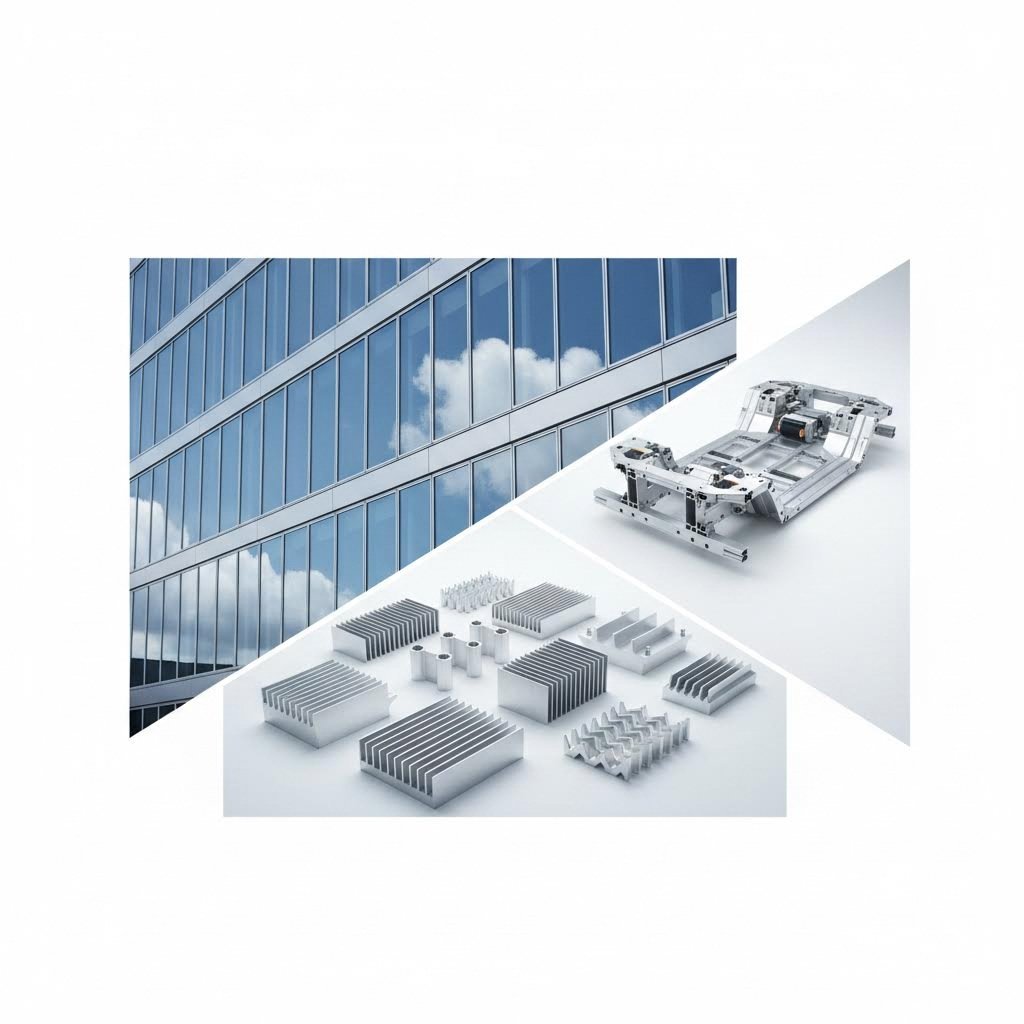
Understanding market projections is one thing. But here's the question that really matters: how do these trends affect your specific industry? The aluminum extrusion market doesn't grow uniformly across all sectors. Different end-use applications experience varying demand patterns, regional dynamics, and competitive pressures. Let's break down what this means for construction professionals, automotive engineers, electronics manufacturers, and industrial equipment buyers.
The building and construction sector holds the largest revenue share in the aluminum extrusion market, according to Precedence Research. This dominance stems from the extensive use of extruded aluminum products in virtually every type of building project, from residential homes to commercial high-rises.
Why do architects and builders favor aluminum extrusions? The material offers an exceptional combination of strength, weather resistance, and design flexibility that few alternatives can match. Unlike steel, aluminum naturally resists corrosion without requiring protective coatings. Unlike wood, it won't warp, rot, or attract pests.
Common aluminium extrusion products in construction include:
For procurement professionals in construction, the practical implication is clear: aluminum extrusion suppliers with architectural expertise offer significant value beyond raw material supply. Look for partners who understand building code requirements, thermal performance specifications, and finishing standards relevant to your regional market.
The automotive aluminum extrusion market represents one of the fastest-growing segments within this industry. According to Precedence Research, the extensive use of aluminum extruded products in diverse automotive applications is expected to drive significant growth through the forecast period.
What's driving this surge? Two converging forces: fuel economy regulations and electric vehicle adoption. Every kilogram saved from a vehicle's weight translates to measurable improvements in efficiency. For internal combustion vehicles, lighter weight means better fuel economy. For electric vehicles, reduced mass extends driving range per charge.
Automotive manufacturers now specify aluminum extrusions for:
The Ford F-150, one of America's best-selling vehicles, exemplifies this trend. Its aluminum body panels and extruded structural shapes account for a significant portion of the body weight, demonstrating how high-volume production can successfully incorporate aluminum extrusions.
For engineers and sourcing managers in automotive, the message is straightforward: aluminum extrusions have moved from niche applications to mainstream specification. Tier 1 suppliers increasingly require partners with automotive-grade quality systems, just-in-time delivery capabilities, and the ability to produce consistent high-volume components.
Beyond construction and transportation, aluminum extruded products serve critical functions in electrical systems, consumer electronics, and industrial equipment. These sectors may command smaller market shares individually, but they often demand the most technically sophisticated profiles.
In electrical and electronics applications, aluminum extrusions appear as:
Industrial machinery applications extend further into manufacturing and transportation infrastructure. Aluminum rail extrusions, for instance, serve as linear motion guides, conveyor frames, and modular framing systems in factory automation. These aluminum rail extrusions offer precise dimensional tolerances critical for equipment that must maintain tight positional accuracy.
Additional industrial applications include:
Where is all this production happening? The answer might surprise those unfamiliar with the industry's geographic concentration. According to Precedence Research, Asia Pacific dominated the aluminum extrusion market with a revenue share exceeding 75% in 2024. The region's market value reached USD 66.73 billion and is expected to grow to approximately USD 126.91 billion by 2034 at a 7% CAGR.
China leads this regional dominance by a substantial margin. The country's extrusion production accounts for approximately 56% of global output, equivalent to 23.5 million tonnes per annum. Total aluminum extrusion usage within China represents 63% of global consumption, with projections suggesting this could reach 69% by 2025.
Several factors explain China's market position:
North America represents another significant growth region, particularly in the United States. The U.S. market is witnessing rapid expansion driven by construction, automotive, aerospace, and consumer goods demand. Government infrastructure investments in transportation, energy, and construction projects further support this growth trajectory.
For investors and analysts, these regional dynamics carry important implications. Companies with established Asian manufacturing presence benefit from proximity to the largest production base. Meanwhile, reshoring trends and trade policies create opportunities for North American and European producers serving domestic markets where supply chain reliability matters.
Understanding these sector-specific and regional patterns helps market participants move beyond generic industry forecasts toward actionable intelligence relevant to their specific business context. The sustainability factors shaping procurement decisions add another dimension worth exploring.
You've probably heard manufacturers claim their products are "sustainable" or "eco-friendly." But when it comes to extruded aluminum stock, these claims carry genuine substance. The sustainability story behind aluminum extrusions goes far beyond marketing buzzwords, touching on fundamental material science, energy economics, and circular economy principles that increasingly drive procurement decisions.
Here's a fact that might surprise you: aluminum is infinitely recyclable. Unlike many materials that degrade with each recycling cycle, aluminum retains its physical and chemical properties completely after reprocessing. According to the Aluminum Extruders Council, over 1 billion tons of primary aluminum have been produced since 1888, and approximately 75% of it remains in productive use today.
The energy equation makes this recyclability even more compelling. Recycling aluminum requires only about 5-8% of the energy needed to produce virgin aluminum from bauxite ore. That's a staggering 92-95% reduction in energy consumption. What does this mean in practical terms?
Each ton of aluminum recycled instead of produced from ore saves:
The recycling rates across different sectors demonstrate market confidence in this circular economy model. According to STACBOND, the overall efficiency rate of aluminum recycling reached 76% globally in 2020. In industrial sectors like automotive and construction, recycling rates often exceed 90%, reflecting these industries' commitment to material recovery.
North American extruders have embraced this model enthusiastically. In 2021, they consumed 4 billion pounds of scrap aluminum, representing 55% of their total material needs. With 170 extrusion facilities operating across 40 U.S. states and Canadian provinces, many running their own remelt operations, the infrastructure for circular aluminum production is well established.
For procurement professionals evaluating large aluminium extrusions or seeking cheap aluminium extrusion options, understanding this recycled content equation matters. Specifying recycled aluminum can reduce material costs while simultaneously improving your project's environmental credentials.
If you're involved in commercial construction, you know that LEED and BREEAM certifications increasingly influence material specifications. How do aluminum extrusions contribute to earning these valuable certifications?
According to Aluprof, modern aluminum facades and window systems support compliance with criteria in both certification systems across multiple categories:
The industry has responded to these certification requirements by developing comprehensive documentation. The Aluminum Extruders Council released Life Cycle Analysis and Environmental Product Declarations covering aluminum extrusion produced in the U.S. and Canada in late 2022, providing the transparency that green building projects require.
Beyond recyclability and certifications, the extrusion industry is actively working to reduce its primary production carbon footprint. In 1995, producing one ton of primary aluminum generated 16.5 tons of CO2 equivalents. By 2018, that figure had dropped to 12.0 tons. Today, multiple producers offer low-carbon primary aluminum with less than 4 tons of CO2 equivalents per ton produced, largely through hydropower and other renewable energy sources.
The sustainability advantages of aluminum in end-use applications compound these production improvements:
The emissions savings from increased aluminum usage in transportation are so substantial that industry analysts project the aluminum sector could become "greenhouse gas neutral" within the next decade. The global warming impact from production would be more than offset by carbon dioxide reductions from transportation applications.
For investors and procurement professionals alike, these sustainability credentials represent more than environmental responsibility. They translate into regulatory compliance advantages, green financing opportunities, and increasingly, competitive differentiation in markets where end customers prioritize environmental performance. As technology advances continue reshaping manufacturing capabilities, the next frontier involves integrating these sustainability benefits with enhanced production efficiency and quality.

What separates a good aluminum extrusion from an exceptional one? Increasingly, the answer lies not just in the base material or die design, but in the sophisticated technologies applied during and after production. The aluminum extrusion market is undergoing a technological transformation that's reshaping how extruded aluminum systems are manufactured, inspected, and finished. For procurement professionals and engineers, understanding these capabilities helps identify suppliers positioned at the industry's leading edge.
Imagine an extrusion press that learns from every billet it processes, automatically adjusting parameters to optimize quality before defects occur. This isn't science fiction. According to BWC Profiles, smart manufacturing systems now blend traditional craftsmanship with real-time digital control, moving extrusion from reactive correction to predictive precision.
Modern extrusion lines deploy sensors throughout the production process, continuously monitoring:
This sensor data feeds into closed-loop control systems that automatically adjust process parameters in response to real-time feedback. If die temperature drifts, extrusion speed corrects itself instantly, maintaining profile integrity without human intervention. The result? Greater consistency, tighter tolerances, and reduced scrap rates.
But automation goes beyond simple feedback loops. AI and machine learning algorithms are now analyzing historical production data to identify patterns invisible to human operators. Applications already emerging across aluminum extrusion products manufacturing include:
Digital twin technology takes this further, creating virtual replicas of extrusion lines, dies, and entire production environments. Before the first billet is heated, engineers can simulate material flow, temperature distribution, and die stress to optimize designs. By coupling digital twins with AI analytics, aluminum impact extrusion companies and traditional extruders alike are shortening die development cycles, reducing trial runs, and improving yield rates.
The Industrial Internet of Things (IIoT) connects these systems across the factory floor. Press PLCs and temperature controllers send live telemetry to central dashboards. Operators monitor deviations via mobile devices. Quality data feeds back into production analytics. Every extrusion cycle informs the next, creating a self-improving manufacturing ecosystem.
Raw extruded profiles rarely go directly to end users. Surface treatments transform base aluminum into finished components with enhanced aesthetics, durability, and functional properties. According to LT Coating Line, selecting the right surface treatment depends on your application requirements, environmental exposure, and budget constraints.
Here's what you need to know about the primary treatment options:
Each treatment involves trade-offs. Anodizing provides unmatched abrasion resistance but has lower chemical resistance than organic coatings. PVDF offers superior weather resistance and color flexibility but scratches more easily than anodized surfaces. Powder coatings eliminate VOC emissions but may show orange peel texture if improperly applied.
For applications demanding specialized properties, additional treatment options include:
Extrusion creates the basic profile shape, but many applications require additional machining to create finished components. According to Eleanor Industries, aluminum profiles offer exceptional machinability, high dimensional accuracy, and corrosion resistance that make them ideal candidates for CNC processing.
Modern CNC machining capabilities extend extrusion possibilities significantly:
The integration of CNC machining with extrusion creates opportunities for hybrid manufacturing approaches. Custom aluminum extrusion profiles can be designed specifically to optimize subsequent machining operations, reducing waste and improving processing speeds. This design-for-manufacturing mindset represents the industry's evolution toward complete component solutions rather than simple material supply.
For buyers evaluating potential suppliers, these technological capabilities matter. Manufacturers investing in smart manufacturing, advanced surface treatments, and precision machining represent the industry's next generation. Their ability to deliver consistent quality, quick turnarounds, and technical support can make the difference between project success and costly delays. Understanding how to evaluate these capabilities systematically brings us to practical procurement considerations.

You've researched the market projections, understood the technical specifications, and identified your application requirements. Now comes the critical question: how do you actually choose the right extruded aluminum manufacturers for your project? This decision directly impacts product quality, lead times, and ultimately your bottom line. Whether you're sourcing aluminium extruded profiles suppliers for a one-time project or establishing a long-term partnership, a systematic evaluation approach separates successful procurement from costly mistakes.
Selecting extruded aluminium suppliers involves far more than comparing price quotes. According to Ya Ji Aluminum, a qualified supplier offers engineering collaboration, quality assurance, and integrated production capabilities that align with your business goals. Think of your supplier as a technical partner rather than simply a vendor.
Here's a comprehensive checklist to guide your evaluation:
Before committing to a full contract, request physical samples to validate extrusion precision, surface finish, and material consistency. If possible, conduct a factory audit or virtual walkthrough to assess machinery condition, cleanliness, and workflow organization. References from companies with similar requirements provide invaluable real-world insights into supplier performance.
Aluminum extrusion cost isn't simply a per-pound material calculation. According to Gabrian International, understanding the components that drive pricing helps you better predict expenses and manage project budgets effectively.
Custom profiles require new dies manufactured from scratch. Tool costs for standard architectural and industrial applications typically range from $400 to $1,000. For larger profiles requiring 2,000-4,000 ton presses, die costs can reach $2,000 or higher. Complex geometries requiring more design time and machining further increase tooling expenses.
Some manufacturers refund tool costs if you purchase a stipulated volume within two years. Most don't charge for replacement dies after their useful life if orders continue. Standard die turnaround runs 3-4 weeks, with production following within a week of sample approval.
Base aluminum pricing represents the largest variable in your total cost equation. The LME (London Metal Exchange) aluminum valuation provides benchmark pricing, but actual costs fluctuate based on global demand, energy costs, and geopolitical factors. Recent years have seen aluminum prices range anywhere from $1,500 to $3,500 per metric ton.
For ongoing production needs, some buyers lock in rates by having extruders purchase metal in advance. This approach makes costs more predictable but requires commitment to future volumes. Unusual alloys not commonly stocked will carry premium pricing for special procurement.
Surface finishing adds measurable costs to your project budget. Typical ranges include:
Working with vertically integrated suppliers who perform extrusion, fabrication, and finishing in-house typically reduces total costs compared to coordinating operations across multiple vendors.
Buying in larger quantities reduces per-unit costs significantly. Fixed expenses like die costs and setup charges spread across more pieces, lowering the average cost per profile. However, balance volume discounts against inventory carrying costs and the risk of specification changes mid-project.
For international sourcing, shipping costs have varied dramatically in recent years. Container shipping from Asia to North America has ranged from $8,000 to as high as $20,000 for a 40-foot container, driven by pandemic disruptions, port congestion, and geopolitical uncertainty.
Additionally, tariffs and anti-dumping duties on imported aluminum products affect landed costs. The shorter lead times and lower production costs in Asia often still provide net savings, but thorough cost analysis including all logistics expenses is essential before committing to offshore suppliers.
Different end-use sectors carry distinct regulatory and certification requirements that influence supplier selection and costs:
Armed with these evaluation criteria and cost considerations, you're positioned to make informed sourcing decisions that balance quality, capability, and budget requirements. The final step involves translating this knowledge into strategic partnerships that support your long-term business objectives.
You've now explored the aluminum extrusion market from multiple angles: technical foundations, growth projections, regional dynamics, sustainability considerations, technological innovations, and procurement best practices. But what does all this mean for your specific situation? Whether you're an investor evaluating market opportunities, a manufacturer planning capacity investments, or a procurement professional building your supplier network, translating market intelligence into actionable strategy is what ultimately drives results.
Different stakeholders approach this market with distinct priorities and decision criteria. Let's break down the key insights relevant to each perspective.
The aluminum extrusion market presents a compelling growth story backed by structural demand drivers rather than cyclical factors. With projections ranging from $160 billion to over $217 billion by the mid-2030s across major research firms, the directional trend remains consistently positive. Several factors strengthen the investment thesis:
Companies demonstrating vertical integration, technological advancement, and sustainability credentials represent particularly attractive opportunities within this sector.
If you're considering capacity expansion or equipment upgrades, the market data supports strategic investment. According to AL Circle Research, extrusions led global aluminum usage in 2024 at 34%, with Asia Pacific experiencing significant growth driven by infrastructure build-outs and automotive lightweighting trends.
Key considerations for capacity planning include:
Your supplier selection directly impacts project success. The evaluation criteria outlined earlier, including production capacity, quality certifications, surface treatment options, and technical support, provide a framework for systematic assessment. Beyond these basics, consider these strategic procurement insights:
The aluminum extrusion industry has evolved from commodity material supply toward comprehensive manufacturing partnerships. Suppliers who combine decades of experience, diverse production capabilities, and integrated processing services represent the model for successful buyer-supplier relationships in this market.
The market's evolution toward full-service manufacturing partnerships reflects a fundamental shift in buyer expectations. Rather than managing separate relationships for die design, extrusion, machining, and finishing, procurement teams increasingly seek partners who deliver complete solutions under one roof.
What does a comprehensive manufacturing partner look like in practice? Consider the capabilities that matter most for complex projects:
Manufacturers like Shengxin Aluminium exemplify this full-service approach. With over 30 years of industry experience, 35 extrusion presses spanning 600T to 5500T capacity, integrated CNC machining centers, and comprehensive surface treatment options including anodizing, powder coating, PVDF, and micro-arc oxidation, they represent the kind of vertically integrated partner that simplifies procurement while ensuring quality.
Whether you're sourcing custom 6063 aluminum tubes, architectural window frames, or complex industrial profiles, partnering with manufacturers who offer end-to-end capabilities from die development through mass production streamlines your supply chain and reduces total cost of ownership.
The aluminum extrusion market's trajectory is clear: sustained growth driven by lightweighting trends, infrastructure investment, and sustainability imperatives. Success in this market, whether as investor, manufacturer, or buyer, depends on translating market intelligence into strategic action. The companies that thrive will be those who embrace technological innovation, prioritize sustainability, and build partnerships based on comprehensive capability rather than transactional pricing alone.
The US aluminum extrusion market was valued at approximately $13.63-14.69 billion in 2024-2025 and is projected to reach $31.04 billion by 2035, growing at a CAGR of 7.77%. This growth is driven by increasing demand from construction, automotive lightweighting initiatives, and infrastructure investments supported by government spending programs.
Common aluminum extrusion challenges include dimensional inaccuracies from irregular cooling or worn dies, surface defects like scratch marks from improper lubrication, and die lines from contaminated billets. Modern manufacturers address these issues through AI-driven quality control, closed-loop temperature monitoring, and predictive maintenance systems that detect potential problems before they affect production.
While raw aluminum commodity pricing averages around $1.17 per pound in 2025, finished extrusions typically cost $2.00-$4.50 per pound or more. Total costs depend on alloy selection, profile complexity, die tooling ($400-$2,000+), surface treatments ($800-$1,400 per metric ton), and volume quantities. Working with vertically integrated suppliers can reduce overall costs.
Three primary forces drive market expansion: automotive lightweighting for improved fuel efficiency and EV range extension, sustainable construction practices supporting green building certifications like LEED and BREEAM, and global infrastructure investment particularly in Asia Pacific where urbanization rates exceed 3% annually. Electric vehicle adoption alone could drive aluminum demand to 10 million tonnes by 2030.
Evaluate suppliers based on press tonnage range (600T-5500T for diverse profiles), quality certifications (ISO 9001, IATF 16949 for automotive), in-house surface treatment capabilities including anodizing and powder coating, and technical support for die development. Full-service partners like Shengxin Aluminium offering end-to-end processing from die development through mass production simplify procurement while ensuring quality consistency.



 خدمة الإنترنت
 0086 136 3563 2360
 sales@sxalu.com
 +86 136 3563 2360
 العربية
 English
 français
 Deutsch
 русский
 español
 português
 ไทย
ไทย Việt
Việt Українська